
Search
Did you mean: Merlin?
Remove Ads
Advertisement
Search Results

Article
Siege of Sevastopol in 1941-2
The siege of Sevastopol (Oct 41 to Jul 42) was an attack by Axis forces on the base of the USSR's Black Sea Fleet during Operation Barbarossa of the Second World War (1939-45). Sevastopol (aka Sebastopol) had one of...
Image
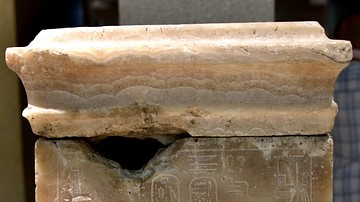
Chest for Canopic Jars of Shoshenq I
This calcite-alabaster chest and its lid were made for storing the canopic jars of Shoshenq I (reigned 943-922 BCE), the founder of the 22nd (Bubastite or Libyan) Dynasty of Egypt. The nomen and prenomen cartouches...

Image
Caffarelli Sarcophagus
This garland sarcophagus, known in drawings since the 15th century CE, originally stood on the Tiber Island in Rome. In a photograph taken between 1864-1866 CE, it is seen surrounded by ornamental plants in the garden of...
Image
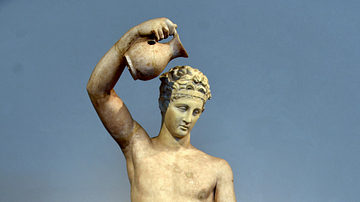
Statue of a Satyr from Sabina
This marble statue came from the Villa at Monte Calvo in Sabina, Italy. In the villa, the boyish satyr was part of a fountain, for the jug is pierced for receiving a water pipe. The Berlin statue belongs to a series...

Image
Statue of Nakht-Hor-heb
Kneeling figure of Nakht-Hor-heb, a military official, holding a shrine. Siltstone. Late Period, 26th Dynasty, reign of Amasis II, 570-526 BCE. From Sais (Sa El Hagar), Egypt Acquired by the Society for the Promotion of...

Image
Cleopatra VII (Artistic Facial Reconstruction)
Facial reconstruction of the Ptolemaic Egyptian queen Cleopatra VII (r. 51-30 BCE). This artistic representation of Cleopatra is primarily based on a bust from the Berlin Altes Museum, widely agreed to...

Image
Head of Polykletian Discophoros
This high-quality head of a statue is based on a bronze figure of a discophoros ("disc-thrower"). The original bronze was created around 460 BCE by the famous Greek sculptor Polykleitos of Argos. The Berlin copy clearly...

Image
Statue of Hor-sa-Tutu
The upper part of the statue of Hor-sa-Tutu has survived. He was the commander-in-chief of the troops in Lower Egypt. From Sais (Sa El Hagar), Egypt. Ptolemaic Period, 150-50 BCE. (The Neues Museum, Berlin, Germany).

Image
Temple Relief of Akhenaten
The Egyptian pharaoh Akhenaten (r. 1353-1336 BCE) appears beneath the rays of god Aten. Painted sandstone. New Kingdom, 18th Dynasty, c. 1350 BCE. From the Temple of Aten at Karnak, Egypt. (The Neues Museum, Berlin, Germany...

Image
Portrait of Akhenaten
Limestone fragment showing a portrait (in Amarna style) of the Egyptian pharaoh Akhenaten (r. 1353-1336 BCE) in profile, looking to the right. Probably from Amarna, Egypt. New Kingdom, 18th Dynasty, c. 1345 BCE. It is on display...
