
Search
Remove Ads
Advertisement
Search Results

Definition
Greek Archaic Period
The Greek Archaic Period (c. 800-479 BCE) started from what can only be termed uncertainty, and ended with the Persians being ejected from Greece for good after the battles of Plataea and Mykale in 479 BCE. The Archaic Period...

Definition
Bai Juyi
Bai Juyi (l. 772-846) was one of the greatest poets of the Tang Dynasty (618-907) along with Li Po (l. 701-762) and Du Fu (l. 712-770). He was a government official who got in trouble with authorities a number of times for not following...

Definition
Hoplite - The Key Infantry Soldier of Ancient Greece
A hoplite (from ta hopla meaning tool or equipment) was the most common type of heavily armed foot-soldier in ancient Greece from the 7th to 4th centuries BCE, and most ordinary citizens of Greek city-states...

Definition
Domitian
Domitian was Roman Emperor from 81 to 96 CE and his reign, although one of relative peace and stability, became engulfed in both fear and paranoia. His death at the hands of those who were closest to him brought an end to the short...

Definition
Etruscan Religion
The religion of the Etruscans, the civilization which flourished from the 8th to 3rd century BCE in central Italy, has, like many other features of the culture, long been overshadowed by that of its Greek contemporaries and Roman...

Definition
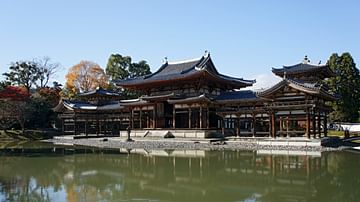
Shinto Architecture
The architecture of the 80,000 Shinto shrines in Japan varies depending on geographical location, the deity worshipped, and the date of foundation. The earlier Shinto shrines tend to be simpler and less decorative affairs than...
Definition
Heian Period
The Heian Period of Japanese history covers 794 to 1185 CE and saw a great flourishing in Japanese culture from literature to paintings. Government and its administration came to be dominated by the Fujiwara clan who eventually were...

Definition
Theogony
The Theogony is an 8th-century BCE didactic and instructional poem, credited to the Greek poet Hesiod. The Theogony was, at first, not actually written down, rather, it was part of a rich oral tradition which only achieved written form...

Definition
Lysistrata
Lysistrata was the third and final of the peace plays written by the great Greek comic playwright Aristophanes (c. 445 - c. 386 BCE). Shown in 411 BCE at the Lenaea festival in Athens, it was written during the final years of the...

Definition
Plutus (Play)
Plutus (aka Wealth) is a play written by the great Greek comedy playwright Aristophanes in 388 BCE. It was the last of his plays to be performed during his lifetime. Like his earlier play Ecclesiazusae (The Assemblywomen), Wealth...
