
Search
Remove Ads
Advertisement
Search Results

Image
Ancient Greek Kithara
A reconstruction of the ancient Greek stringed instrument. It was associated with the god Apollo, regarded as the most gifted player of the instument and patron of musicians. (Museum of Ancient Greek Musical Instruments, Katakolon...

Image
Ancient Greek Sistrum
A modern reconstruction of the ancient Greek musical instrument, the sistrum (rattle). (Museum of Ancient Greek Musical Instruments, Katakolon)
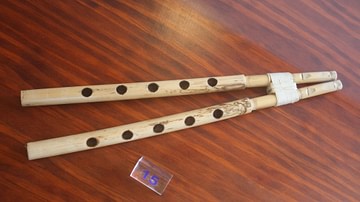
Image
Greek Double Aulos
The ancient Greek double aulos (diaulos) consisted of two pipes (auloi) attached at the mouthpiece and sometimes held in place with a leather strap (forveia) to the player's face. The pipes could be of equal length or unequal...
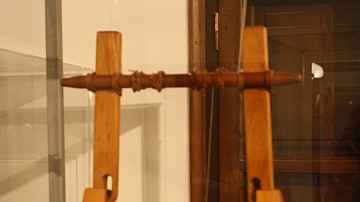
Image
Ancient Greek Forminx
A reconstruction of the forminx, a stringed instrument which was played to a singing accompaniment. (Museum of Ancient Greek Musical Instruments, Katakolon, Greece).
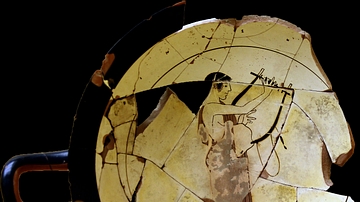
Image
Lyre Plyer
A young male tunes his tortoise-shell lyre, and a hare waits in anticipation.
Fragmentary Kylix, c. 480 BCE. (Museum of the Ancient Agora, Athens)
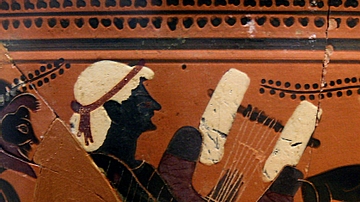
Image
Detail of Kithara Strings
A komast ('after-party reveler') plays his kithara. The body of the instrument is shown in red, the arms in white. The seven strings of the instrument can be clearly seen, also depicted in white. Skyphos by the Theseus...
Image
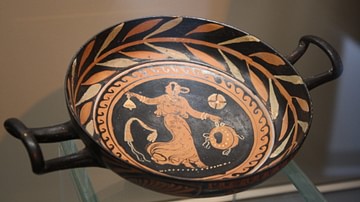
Maenad, Red-Figure Cup
Greek red figure stemless cup from Apula, 330-320 BCE, depicting a dancing maenad - female follower of Dionysus - holding a bell and tambourine. (Archaeological Museum, Milan)
Image
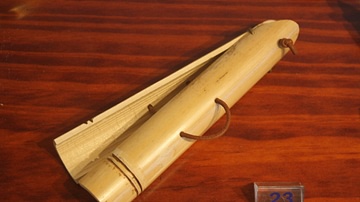
Ancient Greek Clapper
A reconstruction of the clapper (Krotala), an ancient percussion instrument made from cane, shell, wood or metal. Usually held in each hand with thumbs and middle finger through the leather loops for stability, they were played...

Video
Oracles of Ancient Greece
Oracles in the ancient Greek world were the way in which the people of Greece could communicate with their gods. Gods couldn’t be communed with directly, so an oracle, who was often a woman, was the person that the gods...

Video
History of the Iliad and the Trojan War
The Iliad covers not the entire Trojan War, but begins in the midst of events in the final year of battle, after nine years of siege, and only spans 52 days. By the time The Iliad was written down in the eighth...
