
Search
Remove Ads
Advertisement
Search Results

Definition
Charles V, Holy Roman Emperor
Charles V, Holy Roman Emperor (24 February 1500 to 21 September 1558) reigned from 1519 until his abdication in 1556 and was one of the most powerful rulers in the history of the Habsburg dynasty. Through a series of...

Definition
Juan de Grijalva
Juan de Grijalva (aka Grijalba, 1489-1527) was a Spanish conquistador who explored the eastern coast of Mexico in 1518. His notable achievements included a demonstration that the Yucatán Peninsula was just that and not, as previously...

Image
Florentine Codex
The General History of the Things of New Spain or Florentine Codex, an ethnographic codex by Bernardino de Sahagún, Book 7, Folio 9v, Mexico, 16th century. Written in the mid- to late 16th century, this collection of images and...
Definition
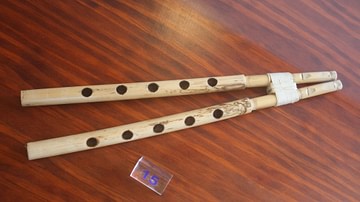
Aulos
The aulos was a musical wind instrument played by the ancient Greeks. It was also known as the kalamos or libykos lotos, which referred to the material from which part of the instrument was made: respectively, the reed and the Libyan...
Definition
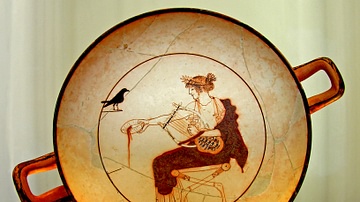
Lyre
The lyre was a stringed musical instrument played by the ancient Greeks. It was probably the most important and well-known instrument in the Greek world. The lyre was closely related to the other stringed instruments: the chelys which...

Definition
Tympanon
The tympanon (tympanum in Latin) was the most popular frame-drum in ancient Greek music, producing a loud rumbling sound not far from the sound of the orchestral timpani drums today. This percussion instrument was played mainly by women...
Definition
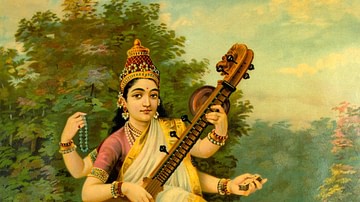
Saraswati
Saraswati (also Sarasvati) is the Hindu goddess of learning, wisdom, music, and aesthetics. She is also known as Bharati (eloquence), Shatarupa (existence), Vedamata ('mother of the Vedas'), Brahmi, Sarada, Vagisvari, and Putkari...

Article
Egyptian Gods - The Complete List
The gods and goddesses of Ancient Egypt were an integral part of the people's everyday lives for over 3,000 years. There were over 2,000 deities in the Egyptian pantheon, many whose names are well known - Isis, Osiris...

Article
Daily Life in Ancient Mesopotamia - Mirroring the Modern World
Daily life in ancient Mesopotamia cannot be described in the same way one would describe life in ancient Rome or Greece. Mesopotamia was never a single, unified civilization, not even under...

Curriculum Collection
AP World History Unit 1 - The Global Tapestry (c. 1200-1450)
Between 1200 and 1450 CE, no single power dominated the world. Instead, a number of powerful civilizations developed in parallel: the Song Dynasty in China, ruled after 1279 by the Mongols; the...
