
Search
Remove Ads
Advertisement
Search Results

Definition
George Berkeley
George Berkeley (1685-1753) was an Anglo-Irish bishop and an empiricist and idealist philosopher. He infamously claimed that no matter exists outside of God and that things only exist outside of our minds and perceptions because...

Definition
Antoine de Chandieu
Antoine de Chandieu (l. 1534-1591) was a French theologian, who played a decisive role in the religious history of the 16th century but remains in the shadow of other French Protestant leaders. Due to his remarkable abilities...

Definition
Plautus
Titus Maccius Plautus, better known simply as Plautus (actually a nickname meaning 'flatfoot'), was, between c. 205 and 184 BCE, a Roman writer of comedy plays, specifically the fabulae palliatae, which had a Greek-themed storyline...
Definition
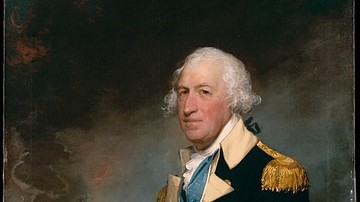
Horatio Gates
Horatio Gates (1727-1806) was an English-born general of the Continental Army during the American Revolutionary War (1775-1783). Initially viewed as a hero for his stunning victory at the Battles of Saratoga, Gates' reputation was...

Definition
Tutankhamun
Tutankhamun (also known as Tutankhamen and `King Tut', r. c.1336-c.1327 BCE) is the most famous and instantly recognizable Pharaoh in the modern world. His golden sarcophagus is now a symbol almost synonymous with Egypt. His name...

Definition
Battleship Bismarck
The Bismarck was a German battleship, the largest and most powerful capital ship in the Kriegsmarine. For all its weaponry and armour, the ship was involved in only one major operation which, after the sinking of the British...

Definition
Roman Nose (Cheyenne Warrior)
Roman Nose (Woqini, "Hook Nose", l. c. 1830-1868) was a Northern Cheyenne warrior known for his courage in battle, who became so famous among white settlers and the US military that they believed he was chief of the...

Definition
Aristarchus of Samos
Aristarchus of Samos (l. c. 310 - c. 230 BCE) was a Greek astronomer who first proposed a heliocentric model of the universe in which the sun, not the earth, was at the center. Although his theory was noted by other thinkers...

Definition
Munich Agreement
The Munich Agreement, signed on 30 September 1938 at the Munich Conference attended by the leaders of Britain, France, Italy, and Germany, handed over the Sudetenland of Czechoslovakia to Germany in the hope that this act of appeasement...

Definition
Legio II Augusta
Legio II Augusta was a legion of the Roman army that, throughout its centuries-long history, had fought in the Cantabrian Wars of 29-19 BCE, Germanicus' German campaigns in 9 CE, the invasion of Britain in 43 CE, and Septimus...
