
Search
Remove Ads
Advertisement
Search Results
Definition
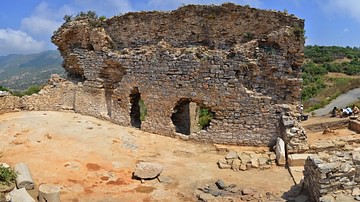
Antiochia ad Cragum
Antiochia ad Cragum (“Antioch on the Cliffs” or “Antioch at Cragus”) was a Hellenistic Roman city located in Cilicia Trachea (“Rough Cilicia”, also known as Cilicia Aspera and Cilicia Secunda) on the southern coast of modern-day...

Collection
Trade & Commerce in Ancient Greece
The ancient Mediterranean was a busy place with trading ships sailing in all directions to connect cities and cultures. The Greeks were so keen on the rewards of trade and commerce that they colonized large parts...
Image
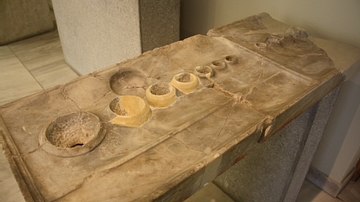
Sekomata (Liquid Measuring Table)
A sekomata used to measure standard quantities of liquids. From the agora of Piraeus. (Archaeological Museum, Piraeus)

Image
Greek Bronze Ballot Disks
Bronze ballot disks used in Greek courts to vote guilty (a hole in the centre) or innocent (a solid centre). c. 300 BCE. (Agora Museum, Athens)

Image
Ostraka for Themistocles
Pottery ostraka identifying Themistocles, 482 BCE. These were used in Athens to vote a particular citizen to be ostracised from the polis. From a well on the north slope of the acropolis of Athens. (Museum of the Ancient...

Image
Kleroteria
Stone kleroteria; a device that randomly dispensed black or white tokens which the Athenians used to select citizens for jury service. (Agora Museum of Athens)

Image
Ostrakon for Pericles
Pottery ostrakon identifying Pericles, 444-443 BCE. These were used in Athens to vote a particular citizen to be exiled from the polis. From a well on the north slope of the acropolis of Athens. (Museum of the Ancient Agora...
Image
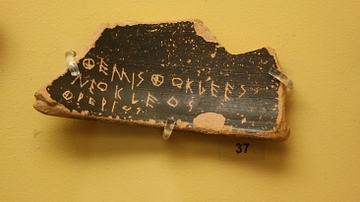
Ostrakon for Themistocles
Pottery ostrakon identifying Themistocles, 480-460 BCE. These were used in Athens to vote a particular citizen to be exiled from the polis. (Museum of the Ancient Agora, Athens)

Article
Diodorus Siculus: The Battle of Chaeronia
In the following excerpt from his Library of History, Book XVI, chapter 14, the historian Diodorus Siculus (1st century BCE) chronicles the famous Battle of Chaeronia of 338 BCE, in which Phillip II of Macedon...

Article
Hipparchia the Cynic: Devoted Wife, Mother, & Outspoken Greek Philosopher
Cynic philosopher, wife of Crates of Thebes (l. c. 360 – 280 BCE), and mother of his children, Hipparchia of Maroneia (l. c. 350 – 280 BCE) defied social norms in order to live her...
