
Search
Remove Ads
Advertisement
Search Results

Definition
Roman Army
The Roman army, famed for its discipline, organisation, and innovation in both weapons and tactics, allowed Rome to build and defend a huge empire which for centuries would dominate the Mediterranean world and beyond. Overview...

Article
The Red Army in WWII
The Red Army of the USSR began the Second World War (1939-45) with a series of shocking defeats, but from late 1942, it rallied and held on to key cities like the capital Moscow, Leningrad (Saint Petersburg), and Stalingrad...

Definition
Tiglath Pileser III
Tiglath Pileser III (745-727 BCE) was among the most powerful kings of the Neo-Assyrian Empire and, according to many scholars, the founder of the empire (as opposed to the claims for Adad Nirari II (912-891 BCE) or Ashurnasirpal...
Definition
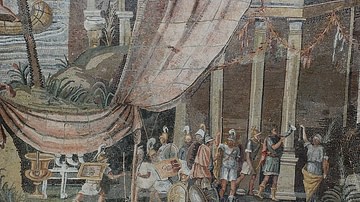
Ptolemaic Army
The army of Ptolemaic Egypt was a well-organized fighting force trained in Hellenistic warfare. The Ptolemaic dynasty used their considerable wealth to maintain a large standing army of professional soldiers. Some troops were paid...

Definition
Sargon II
Sargon II (r. 722-705 BCE) was one of the most important kings of the Neo-Assyrian Empire as founder of the Sargonid Dynasty which would rule the empire for the next century until its fall. He was a great military leader, tactician...

Definition
Sennacherib
Sennacherib (r. 705-681 BCE) was the second king of the Sargonid Dynasty of Assyria (founded by his father Sargon II, r. 722-705 BCE). He is one of the most famous Assyrian kings owing to the part he plays in narratives in the biblical...
Definition
Sargonid Dynasty
The Sargonid Dynasty was the last ruling house of the Neo-Assyrian Empire from 722-612 BCE, beginning with the reign of Sargon II and ending with fall of the Neo-Assyrian Empire. Some of the most famous kings in the history of...

Article
Wall Reliefs: Apkallus of the North-West Palace at Nimrud
Religion is the sigh of the oppressed creature, the heart of a heartless world, and the soul of soulless conditions. It is the opium of the people. (Karl Marx, Critique of Hegel's Philosophy of...

Definition
Ashurbanipal
Ashurbanipal (r. 668-627 BCE, also known as Assurbanipal) was the last of the great kings of Assyria. His name means "the god Ashur is creator of an heir" and he was the son of King Esarhaddon of the Neo-Assyrian Empire. In the Hebrew...

Definition
Carthaginian Army
The armies of Carthage permitted the city to forge the most powerful empire in the western Mediterranean from the 6th to 3rd centuries BCE. Although by tradition a seafaring nation with a powerful navy, Carthage, by necessity...
