
Search
Remove Ads
Advertisement
Search Results

Definition
Terracotta Army
The Terracotta Army refers to the thousands of life-size clay models of soldiers, horses, and chariots which were deposited around the grand mausoleum of Shi Huangdi, first emperor of China and founder of the Qin dynasty, located...

Article
The Army of Alexander the Great
No military commander in history has ever won a battle by himself. To be successful he needs the support of a well-trained army who will follow him regardless of the cost whether it be a stunning victory or hopeless...

Definition
Assur - The Supreme God of the Ancient Assyrians
Assur (also Ashur, Anshar) is the god of the ancient Assyrians who was elevated from a local deity of the city of Ashur to the supreme god of the Assyrian pantheon. His attributes were drawn from earlier...

Article
Officers of the Roman Army
With the appearance of the legionary, the Roman army was able to maintain a vast empire that totally embraced the Mediterranean Sea. Although the success of the army rested on the backs of the foot-soldiers and cavalry...
Definition
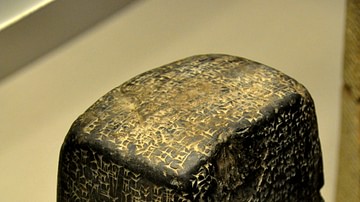
Adad Nirari I
Adad Nirari I (r. 1307-1275 BCE) was the king of the Assyrian Empire who initiated the first major expansion of the Assyrian kingdom from the city of Ashur throughout the region of Mesopotamia. He also instituted what would become...

Definition
Ashur - The First Great Assyrian City
Ashur (also known as Assur) was an Assyrian city located on a plateau above the Tigris River in Mesopotamia (today known as Qal'at Sherqat, al-Shirqat District, northern Iraq). The city was an important center...

Image Gallery
A Gallery of Assyrian Warfare
The Assyrian military was the most effective – and feared – fighting force in the Near East, especially during the time of the Neo-Assyrian Empire, 912-612 BCE, when their territory expanded across Mesopotamia, the...

Definition
Tukulti-Ninurta I
Tukulti-Ninurta I (reigned 1244-1208 BCE) was a king of the Assyrian Empire during the period known as the Middle Empire. He was the son of Shalmaneser I (reigned 1274-1245 BCE) who had completed the work of his father, Adad...

Article
Battle of Stalingrad - The Destruction of Germany's Sixth Army
The Battle of Stalingrad (now Volgograd, July 1942 to February 1943) was an attempt by Adolf Hitler (1889-1945) to control the USSR's access to the Caucasus oil fields. Fierce street-fighting...

Image Gallery
A Gallery of Neo-Assyrian Kings
The Neo-Assyrian kings are among the best-known of the Assyrian Empire and include Tiglath Pileser III, Shalmaneser III, Sargon II, Sennacherib, Esarhaddon, and Ashurbanipal. The term Neo-Assyrian is a modern-day designation...
