
Search
Did you mean: Aria?
Remove Ads
Advertisement
Search Results

Definition
Religion in the Ancient World - Order and the Spiritual Experience
Religion (from the Latin Religio, meaning "restraint," or Relegere, according to Cicero, meaning "to repeat, to read again," or, most likely, Religionem, "to show respect for what is sacred"...

Definition
Didache
The Didache (Koine Greek: διδαχή), also known as “The Teaching,” or, “The Teaching of the Twelve Apostles,” is an enigmatic primitive Church document describing early Christian ethics, practices, and order. Discovery & Dating The...

Definition
Themis
Themis is the personification and goddess of divine law, will, and justice in Greek mythology. She was held in high esteem by the Olympians, often sitting by Zeus' throne and giving him wise counsel. Themis held the place of Oracle at...

Definition
Works and Days
Works and Days is an epic poem written in dactylic hexameter, credited to the 8th-century BCE Greek poet Hesiod. Hesiod is generally remembered for two epic works, Theogony and Works and Days but, like his contemporary Homer, he...

Definition
Urartu Civilization
Urartu, also known as the Kingdom of Urartu or the Kingdom of Van, was a civilization which developed in the Bronze and Iron Age of ancient Armenia, eastern Turkey, and northwestern Iran from the 9th century BCE. Controlling...

Definition
Armenian Mythology
The mythology of ancient Armenia is a rich blend of indigenous traditions with imported ideas from neighbouring cultures and migrating peoples added over the centuries. The legends and stories helped to explain natural phenomena...
Definition
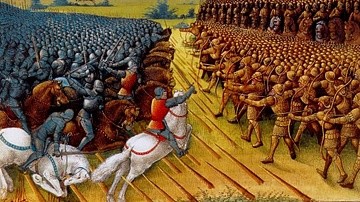
Battle of Nicopolis
The Battle of Nicopolis in September 1396 CE, also known as the Nicopolis Crusade, was an attempt by French, Hungarian, and other European allies to curb the threat of the Ottoman Turks as they pressed ever westwards into Europe...

Definition
Cherub
A cherub (pl. cherubim) was a divine being who dwelt in the heavenly realm of the gods, either as a servant or a mediator between humans and the divine. The word most likely derived from the Akkadian karabu ("to bless"). The cherubim...

Definition
Homo Habilis
Homo habilis ("handy man") is an extinct species of human that lived in East and South Africa between 2.3 and 1.5 million years ago and plays an interesting role in the discussion surrounding the dawn of our genus of Homo, which...

Definition
Hyperborea
In Greek mythology, Hyperborea was the land located to the far north of the known world and it was so remote it was considered even beyond the North Wind. There a legendary race known as the Hyperboreans lived and worshipped the sun...
