
Search
Remove Ads
Advertisement
Search Results

Article
Most Popular Gods & Goddesses of Ancient China
There were over 200 gods and goddesses worshipped throughout ancient China, but if one were to count every deity or spirit, the number would be over 1,000. Each town, village, city, field, farm, and sometimes...

Article
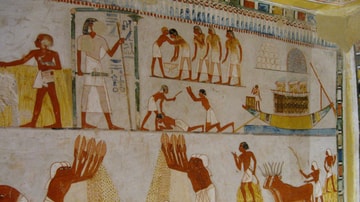
Ancient Egyptian Taxes & the Cattle Count
The gods of ancient Egypt freely gave their bounty to the people who worked the land, but this did not exempt those farmers from paying taxes on that bounty to the government. Egypt was a cashless society until...
Article
Social Structure in Ancient Egypt
The society of ancient Egypt was strictly divided into a hierarchy with the king at the top and then his vizier, the members of his court, priests and scribes, regional governors (eventually called 'nomarchs'), the...

Teaching Bundle
Ancient Rome Teaching Resource Bundle
This Ancient Rome Teaching Resource Bundle is a collection of teaching resources that can be downloaded for free – no registration required. Our teaching resources and lesson plans are adapted to students'...

Definition
Ishtar
Ishtar (Inanna in Sumerian sources) is a primary Mesopotamian goddess closely associated with love and war. This powerful Mesopotamian goddess is the first known deity for which we have written evidence. While largely unknown in the modern...

Definition
Critias
Critias (l. c. 460-403 BCE) was an Athenian politician, poet, and playwright, one of Socrates' followers, Plato's second cousin, a leading member of the Thirty Tyrants of Athens, and leader of the oligarchy they established. He is referenced...

Article
Dogs and Their Collars in Ancient Mesoamerica
Dogs were an integral aspect of the lives of the people of Mesoamerica regardless of their location or culture and, throughout the region, were recognized as liminal beings belonging not only to the natural...

Video
Ancient Celtic History, Origin and Culture
The Ancient Celtic people were never a unified empire, but were individual and complex tribes that shared the Celtic language, and through the trade of goods and ideas, shared similarities in art, warfare...

Definition
Garden of Eden
The Garden of Eden is the biblical earthly paradise created by God to be inhabited by his first human creation - Adam and Eve. Some claim that the name “Eden” derives from the Akkadian term edinu, which means 'plain'. In the biblical...

Article
Plague in the Ancient & Medieval World
The word 'plague', in defining a lethal epidemic, was coined by the physician Galen (l. 130-210 CE) who lived through the Antonine Plague (165 - c. 180/190 CE) but the disease was recorded long before in relating...
