
Search
Remove Ads
Advertisement
Search Results

Definition
The Art of War
The Art of War (Sunzi bingfa) is a 5th-century BCE military treatise written by the Chinese strategist Sun-Tzu (aka Sunzi or Sun Wu). Covering all aspects of warfare, it seeks to advise commanders on how to prepare, mobilise, attack...

Image Gallery
A Gallery of Chinese Art & Architecture
Chinese culture developed from small communities such as Banpo Village (c. 4500 BCE) through the early Xia Dynasty (c. 2070-1600 BCE) and the great dynastic periods that followed after, creating some of the...

Article
Most Popular Gods & Goddesses of Ancient China
There were over 200 gods and goddesses worshipped throughout ancient China, but if one were to count every deity or spirit, the number would be over 1,000. Each town, village, city, field, farm, and sometimes...

Collection
History of Chinese Literature
Ancient Chinese literature developed following the evolution of script which evolved from divination practices of the Shang Dynasty (1600-1046 BCE). The pictographs made on oracle bones by diviners became the script...

Definition
Ancient Korean Coinage
The coinage of ancient Korea (pre-13th century CE) first employed Chinese coins, known locally as the oshuchon. Korean rulers began minting their own metal coins from the late 10th century CE, first in copper and iron, and...

Collection
Warfare in Classical Greece
The ancient Greek city-states were in a constant rivalry for land, resources and power which meant that warfare became an ever-present aspect of life. Athens and Sparta were famous rivals throughout the Classical period...

Definition
Zheng Yi Sao
Zheng Yi Sao (aka Ching Shih, Cheng I Sao, Ching Yih Saou or Mrs Cheng, d. 1844) was the chief of a massive pirate confederation which plundered the South China Sea in the early 19th century. She inherited the role from her late...
Article
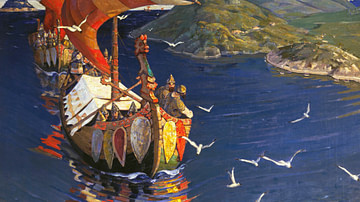
Trade & Warfare in the Kievan Rus
Scandinavians from the island of Gotland began to spread throughout the Baltic region along the Russian rivers in the 700s. While the Vikings of Norway and Denmark from the 8th to 11th centuries are widely recognized...

Image Gallery
A Gallery of Assyrian Warfare
The Assyrian military was the most effective – and feared – fighting force in the Near East, especially during the time of the Neo-Assyrian Empire, 912-612 BCE, when their territory expanded across Mesopotamia, the...

Interview
Rubin Museum's Faith and Empire: Tibetan Buddhist Art
Faith and Empire: Art and Politics in Tibetan Buddhism, a new exhibition at the Rubin Museum of Art in New York, explores the dynamic historical intersection of politics, religion, and art as reflected...
