
Search
Remove Ads
Advertisement
Search Results

Definition
Manuel I Komnenos
Manuel I Komnenos was emperor of the Byzantine Empire from 1143 to 1180 CE. Manuel continued the ambitious campaigns of his grandfather Alexios I and father John II to aggressively expand the boundaries of his empire. Manuel...

Definition
Ancient Israelite Art
Ancient Israelite art traditions are evident especially on stamps seals, ivories from Samaria, and carvings, each with motifs connecting it to more general artistic traditions throughout the Levant. Ancient Israel, and therefore...

Article
Battles & Conquests Of The Ottoman Empire (1299-1683)
Spanning across three continents and holding dominance over the Black and Mediterranean Seas, the Ottoman Sultanate (1299-1922) was a global military superpower between the 15th and 17th centuries...
Image
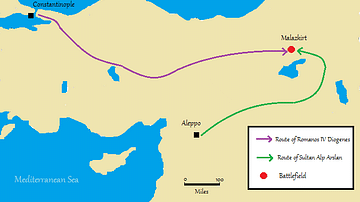
Location Map of the Battle of Manzikert, 1071 CE
A map indicating the location of the Battle of Manzikert in August 1071 CE. The battle in Armenia was one of the greatest defeats suffered by the Byzantine Empire. The victorious Seljuk army led by the...

Definition
Phoenician Religion
The Phoenician Religion, as in many other ancient cultures, was an inseparable part of everyday life. Gods such as Baal, Astarte, and Melqart had temples built in their name, offerings and sacrifices were regularly made to...

Definition
Assur - The Supreme God of the Ancient Assyrians
Assur (also Ashur, Anshar) is the god of the ancient Assyrians who was elevated from a local deity of the city of Ashur to the supreme god of the Assyrian pantheon. His attributes were drawn from earlier...

Definition
Phoenicia
Phoenicia was an ancient civilization composed of independent city-states located along the coast of the Mediterranean Sea stretching through what is now Syria, Lebanon and northern Israel. The Phoenicians were a great maritime people...

Definition
Neo-Assyrian Empire
The Neo-Assyrian Empire (912-612 BCE) was the final stage of the Assyrian Empire, stretching throughout Mesopotamia, the Levant, Egypt, Anatolia, and into parts of Persia and Arabia. Beginning with the reign of Adad Nirari...

Article
The Phoenician Alphabet & Language
Phoenician is a Canaanite language closely related to Hebrew. Very little is known about the Canaanite language, except what can be gathered from the El-Amarna letters written by Canaanite kings to Pharaohs Amenhopis...

Image
Assyrian Warriors Relief
Basalt reliefs depicting Assyrian warriors of different ranks in procession with a royal chariot led by the commander-in-chief of the Assyrian army. The reliefs were acquired and gathered during the years 1848, 1946, 1948...
