
Search
Search Results
Image
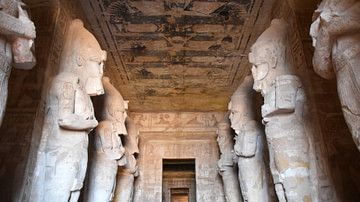
Abu Simbel, Interior of the Temple of Ramesses II
The hypostyle hall of the Temple of Ramesses II at Abu Simbel is 18 m (59 ft) long and 16.7 m (55 ft) wide and is supported by eight massive pillars depicting the deified Ramesses linked to the god Osiris. The temple's interior is decorated...

Image
Egyptian Djed
A gilded wooden and faience djed amulet (symbol of stability) from the tomb of Queen Nefertari, 19th Dynasty, 1279-1213 BCE.
Egyptian Museum, Turin.
Image
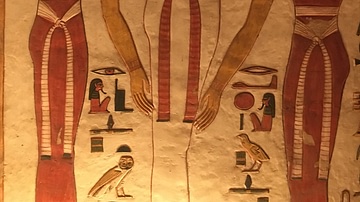
Khnum, Isis & Nephthys
The god Khnum standing between the twin goddesses Isis and Nephthys. From the Tomb of Nefertari in the Valley of the Queens. Thebes, Egypt. 19th Dynasty (1292-1186 BCE).

Image
Approaching Abu Simbel by Boat
The two rock-cut temples of Abu Simbel (the Great Temple of Ramesses II and the Small Temple of his wife Nefertari) are situated on the west bank of the Nile in southern Egypt. As a result of the construction of the Aswan High Dam in the...
Image
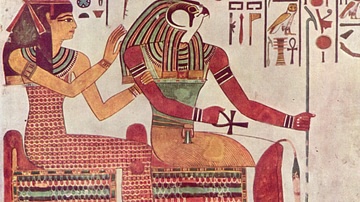
Depiction of Ra Horakhty
A relief portraying Ra or Ra Horakhty, with the goddess Imentet seated behind him. From the Tomb of Nefertari in the Valley of the Queens. Thebes, Egypt. 19th Dynasty (1292-1186 BCE).
Image
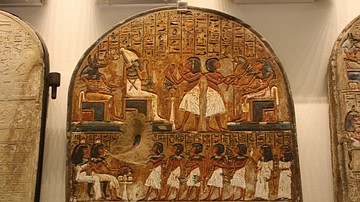
Minhotep & Nakhtmin Relief Stele
A sandstone relief stele depicting in the top panel Minhotep and his son Nakhtmin making offerings to Hathor, Anubis, and Osiris. The middle panel shows Minhotep and his wife Nefertari. The bottom panel shows Nakhtmin and his wife Sekhmet...
Image
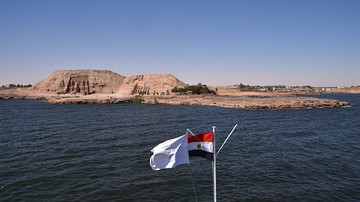
View of Abu Simbel from Lake Nasser
The two rock-cut temples of Abu Simbel (the Great Temple of Ramesses II and the Small Temple of his wife Nefertari) are situated on the west bank of the Nile in southern Egypt. As a result of the construction of the Aswan High Dam in the...

Image
Temple of Hathor, Abu Simbel
Temple of Hathor or "Small Temple" - constructed during the 19th Dynasty. On the facade, six colossuses represent Rameses II (1290-1223 BCE) and his wife, Queen Nefertari, shown as the Goddess Hathor. Alongside each colossus are small figures...

Image
Map of the New Kingdom of Egypt c. 1250 BCE
The New Kingdom of Egypt (c. 1570–1069 BCE) marks the apex of ancient Egypt’s political power, territorial expansion, and imperial ambition. Emerging from the expulsion of the Hyksos and the reunification of Egypt under Ahmose I (reign c...

Image
Comparative Timelines of Egypt & Kush
From c. 3150 - 2400 BCE, the nutrient-rich banks of the Nile River gave rise to two major civilizations: Egypt and Kush. Contact between the two began as early as c. 3150 BCE, with the first Egyptian expeditions (a mixture of military raids...
