
Search
Remove Ads
Advertisement
Search Results

Definition
Antisthenes of Athens
Antisthenes of Athens (l. c. 445-365 BCE) was a Greek philosopher who founded the Cynic School. He was a follower of Socrates and appears in Plato's Phaedo as one of those present at Socrates' death. He is also one of the primary interlocutors...

Article
The Delian League, Part 4: The Ten Years War (431/0-421/0 BCE)
This text is part of an article series on the Delian League. The fourth phase of the Delian League encompasses the first part of the Great Peloponnesian War, also referred to as the Ten Years War, sometimes called quite incorrectly The Archidamian...
Definition
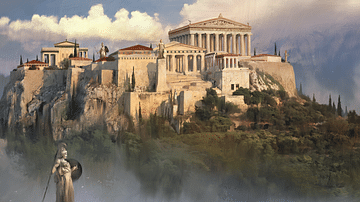
Acropolis
An acropolis is any citadel or complex built on a high hill. The name derives from the Greek akro, "high" or "extreme/extremity" or "edge", and polis, "city", translated as "high city", "city on the edge" or "city in the air", the most famous...

Article
Pausanius' Guide To Ancient Athens
Pausanius (l. 110-180 CE) was a geographer and historian who traveled extensively, taking notes on points of interest, then wrote on them in guide books which could be used by tourists visiting the sites described. His works have long been...

Article
Life of Plato of Athens
Plato of Athens (424 or 423 to 347 BCE) was an ancient Greek philosopher whose work is considered so important that he may be called the inventor of philosophy as we understand the term today. Some people would want to reserve that honor...
Article
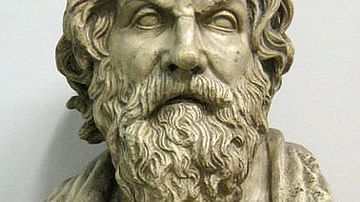
The Life of Antisthenes of Athens in Diogenes Laertius
Antisthenes (c. 445-365 BCE) was a Greek philosopher who founded the Cynic School of Athens. He was a follower of Socrates and appears in Plato's Phaedo as one of those present at Socrates' death. He is one of the primary interlocutors in...

Video
Athens, Greece: Ancient Acropolis and Agora
More info about travel to Athens: http://www.ricksteves.com/europe/greece/athens Crowned by the mighty Parthenon temple, the Acropolis rises above modern Athens; a lasting testament to Greece's glorious golden age. The Acropolis was the...

Image
Speaker's Platform, Athens Assembly, Pnyx, Athens
The platform on the Pnyx hill where speakers stood to address the Athenian democratic assembly in the 5th century BCE. The space dedicated for the assembly could hold 6000 people.
Article
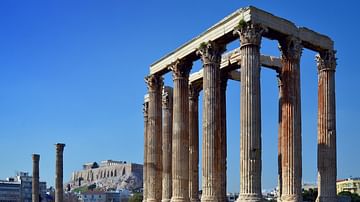
Temple of Olympian Zeus, Athens
The Temple of Olympian Zeus in Athens, also known as the Olympieion, was built over several centuries starting in 174 BCE and only finally completed by Roman emperor Hadrian in 131 CE. Its unusually tall columns and ambitious layout made...
Image
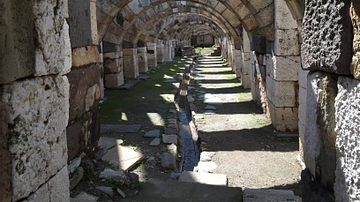
Aqueduct, Agora of New Smyrna
The present structures in New Smyrna's agora date from after 178 CE when an earthquake destroyed the earlier agora. This was not mainly a commercial agora, but rather functioned for stately matters. This lower level had many different functions...
