
Search
Did you mean: Writing?
Remove Ads
Advertisement
Search Results

Article
The Island Kingdom of Aegina: The Old Gods Still Whisper Their Truths
Today, traveling an hour by ferry from Piraeus, the port of Athens, the first remnant of Aegina's great past a visitor will see is the lonely pillar of Apollo rising from the trees on...

Article
Zenobia's Rebellion in the Historia Augusta
The Historia Augusta (Great History) is a Latin work of the 4th century CE that chronicles the lives of Roman emperors from 117-285 CE. Among the many stories related is the history of Zenobia of Palmyra...
Article
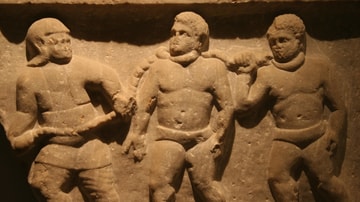
The Spartacus Revolt
The revolt of the gladiator Spartacus in 73-71 BCE remains the most successful slave revolt in the history of Rome. The rebellion is known as the Third Servile War and was the last of three major slave revolts which Rome suppressed...

Article
The Marduk Prophecy - Travels of the Statue of a Babylonian God
The Marduk Prophecy is an Assyrian document dating to between 713 and 612 BCE found in a building known as The House of the Exorcist, adjacent to a temple in the city of Ashur. It relates the...

Article
Weapons in Ancient Egypt
The ancient Egyptian military is often imagined in modern films and other media as a heavily armed and disciplined fighting force equipped with powerful weapons. This depiction, however, is only true of the Egyptian army...

Article
Music & Dance in Ancient Egypt
Music and dance were highly valued in ancient Egyptian culture, but they were more important than is generally thought: they were integral to creation and communion with the gods and, further, were the human response...

Article
The Masaesyli and Massylii of Numidia
The North African Berber kingdom of Numidia (202-40 BCE) was originally inhabited by a tribe (or federation of tribes) known as the Masaesyli, to the west, and a coalition of smaller tribes, known as the Massylii...

Article
Women in the Middle Ages
The lives of women in the Middle Ages were determined by the Church and the aristocracy. The medieval Church provided the 'big picture' of the meaning of life and one's place while the aristocracy ensured that everyone...

Article
Ancient Celtic Society
The society of the Celts in Iron Age Europe was made up of several distinct hierarchical groups. At the top were rulers and elite warriors, then there were the religious leaders, the druids, and then specialised craftworkers...

Article
Heraclitus' Fragments
Heraclitus of Ephesos (l. c. 500 BCE) was an early Pre-Socratic philospher who claimed that the First Cause of existence was fire and that life itself was characterized by strife and change. Heraclitus did not see this condition...
