
Search
Did you mean: Writing?
Remove Ads
Advertisement
Search Results
Definition
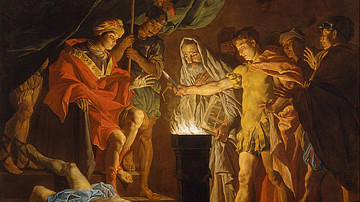
Lars Porsenna
Lars Porsenna was the semi-legendary Etruscan king of Chiusi who famously attacked and probably occupied Rome c. 508 BCE when the city had just exiled its last king and was moving towards becoming a republic. His extravagant tomb...
Definition
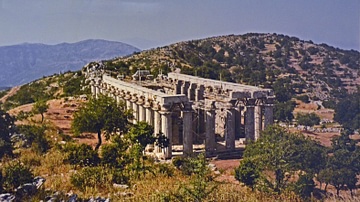
Bassae
Bassae (Bassai), located in south-west Arcadia on the slopes of Mt. Kotilion, was an important temple site in the Archaic and Classical periods. Its large 5th-century BCE temple of Apollo, now covered with a permanent roof, is one of...

Definition
Etruscan Religion
The religion of the Etruscans, the civilization which flourished from the 8th to 3rd century BCE in central Italy, has, like many other features of the culture, long been overshadowed by that of its Greek contemporaries and Roman...

Definition
Old Testament
Old Testament is the Christian name for the books of the Jewish scriptures that constitute the first half of the Christian Bible. "Old" in this sense was a means to distinguish Judaism from Christianity at the creation of the New...

Definition
Khor Virap
Khor Virap is a monastery located in Armenia that was first established in 642 CE. Its name is derived from "virap nerk'in," which means "deep dungeon" in Armenian. Khor Virap is one of the most sacred and visited sites in Armenia...

Definition
Saint Columbanus
Saint Columbanus or “Columbán” (543-615 CE) was one of the greatest missionaries of the early Catholic Church who led the “Hiberno-Scottish mission” of conversion across much of what is now Western Europe in the late 6th and early...

Definition
Medieval Folklore
Medieval folklore is a body of work, originally transmitted orally, which was composed between the 5th and 15th centuries in Europe. Although folktales are a common attribute of every civilization, and such stories were being...

Definition
The Medieval Church
Religious practice in medieval Europe (c. 476-1500) was dominated and informed by the Catholic Church. The majority of the population was Christian, and "Christian" at this time meant "Catholic" as there was initially no other...

Definition
Electra by Euripides
Electra is a Greek tragedy written by the playwright Euripides, c. 420 BCE. It retells the classic myth concerning the plotting of Electra and her brother Orestes to kill their mother and her lover. This version of the story...

Definition
Dante Alighieri
Dante Alighieri (1265-1321) was an Italian poet and politician most famous for his Divine Comedy (c. 1319) where he descends through Hell, climbs Purgatory, and arrives at the illumination of Paradise. Dante meets many historical...
