
Search
Did you mean: Epona?
Remove Ads
Advertisement
Search Results

Definition
First Battle of the Somme - Britain's Greatest Military Tragedy
The First Battle of the Somme took place in northern France during the First World War from 1 July to 18 November 1916. The battle (not to be confused with the Second Battle of the Somme, aka...

Definition
Theodosian Walls
The Theodosian Walls are the fortifications of Constantinople, capital of the Byzantine Empire, which were first built during the reign of Theodosius II (408-450 CE). Sometimes known as the Theodosian Long Walls, they built upon...
Definition
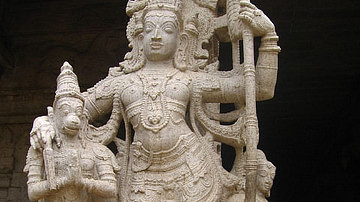
Rama - Seventh Avatar of Vishnu
Rama (or Ramacandra) is the seventh avatar of the Hindu god Vishnu. His adventures include the slaying of the demon king Ravana which is recounted in the Vana Parva of the Mahabharata and in the Ramayana, the oldest...

Definition
Inca Warfare
The warfare of the Inca civilization was characterised by a high degree of mobility, large-scale engagements of hand-to-hand combat, and the establishment of a network of fortresses to protect an empire of over 10 million subjects...

Definition
Constans II
Constans II (aka Konstans II) was emperor of the Byzantine Empire from 641 to 668 CE. Sometimes known as Constans Pogonatos (“the Bearded”), he came to the throne by a series of unlikely events and his empire was immediately challenged...

Definition
Ancient Indian Warfare
War was the chief means by which territory was annexed or rulers defeated in ancient India, which was divided into multiple kingdoms, republics and empires. Often one empire predominated or different empires co-existed...

Definition
Genghis Khan
Genghis Khan (aka Chinggis Khan) was the founder of the Mongol Empire which he ruled from 1206 until his death in 1227. Born Temujin, he acquired the title of Genghis Khan, likely meaning 'universal ruler’, after unifying the Mongol...

Definition
Edward IV of England
Edward IV of England ruled as king from 1461 to 1470 CE and again from 1471 to 1483 CE. The Hundred Years' War (1337-1453 CE) had been lost by Edward's predecessor, Henry VI of England (1422-1461 CE & 1470-1471 CE), leaving...

Definition
Kosrau I
Kosrau I (r. 531-579 CE) was the greatest king of the Sassanian Empire (224-651 CE) in virtually every aspect of his reign. He reformed the military, the Persian government, expanded his territories, engaged in large-scale building...

Definition
Parthian Culture
Stretching between China and India in the east to the Mediterranean in the west, Parthia ruled over one of the widest expanses of empire in its time and Parthian culture flourished for 500 years (247 BCE to 224 CE). While known...
