
Search
Remove Ads
Advertisement
Search Results

Image
Two Statues of Shalmaneser III at the Iraq Museum
In the centre of this image is the so-called Kurba'il statue of Shalmaneser III (reigned 858-824 BCE), which was found in Fort Shalmaneser in 1961 CE by the British School of Archaeology in Iraq. The...
Image
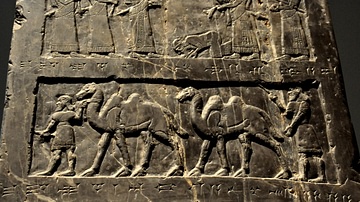
The Black Obelisk of Shalmaneser III, side A, 3rd register
Attendants bring tribute from Musri with two-humped camels. Musri, meaning a borderland, probably refers to a country in eastern Iran or in Egypt. From Nimrud, (ancient Kalhu), near the building...
Image
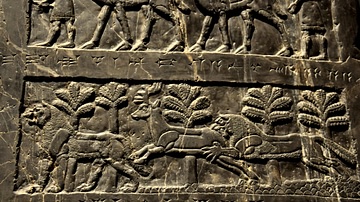
The Black Obelisk of Shalmaneser III, side A, 4th register
Lions and a stag from Marduk-apla-usur the Suhean, probably for the Royal hunting park. Suhi is an area on the middle Euphrates, between modern Syria and Iraq. From Nimrud, (ancient Kalhu), near...

Image
The Black Obelisk of Shalmaneser III, side A, 5th register
Tribute from Qarparunda the Patinean: silver, gold, tin, "fast" bronze, ivory (tusks), and ebony. Patina is modern Antakya, south of Turkey. From Nimrud, (ancient Kalhu), near the building...

Definition
David II of Scotland
David II of Scotland ruled as king from 1329 to 1371 CE. Succeeding his father Robert the Bruce (r. 1306-1329 CE) when still a child, his early reign was threatened by the pretender Edward Balliol (c. 1283-1364 CE), son of...

Definition
War of the Second Coalition
The War of the Second Coalition (1798-1802), part of the broader French Revolutionary Wars, was the second attempt by an alliance of major European powers to defeat Revolutionary France. The Second Coalition, which included...

Article
Interrelations of Kerma and Pharaonic Egypt
The vacillating nature of Ancient Egypt's associations with the Kingdom of Kerma may be described as one of expansion and contraction; a virtual tug-of-war between rival cultures. Structural changes in Egypt's...
Image
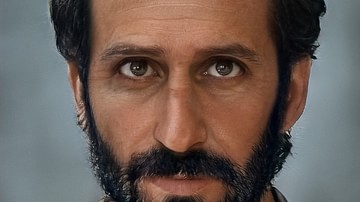
Darius III (Artistic Facial Reconstruction)
A photorealistic representation of the Persian king Darius III (r. 336-330 BCE) as he may have appeared. This reconstruction is largely based on artistic evidence like the Alexander Mosaic (c. 100 BCE) and...

Image
Demolition of the Monument to Alexander III in Moscow
Photograph of the demolition of the monument to Alexander III in Moscow, July 1918. As Tsarist Russia fell in 1917, so did the monuments of its monarchs. The colossal bronze statue to Alexander III...
Image
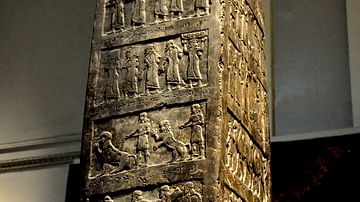
The Black Obelisk of King Shalmaneser III
This obelisk was erected as a public monument in 825 BCE at a time of civil war. The relief sculptures glorify the achievements of King Shalmaneser III and his commander-in-chief . It lists their military campaigns...
