
Search
Remove Ads
Advertisement
Search Results

Definition
Carthage
Carthage was a Phoenician city-state on the coast of North Africa (the site of modern-day Tunis) which, prior the conflict with Rome known as the Punic Wars (264-146 BCE), was the largest, most affluent, and powerful political entity...

Article
Legions of Mesopotamia, Cappadocia, & Arabia
As the Roman Empire expanded further eastward, annexing territories that were once the domain of the Parthians, the legions of Mesopotamia, Cappadocia, and Arabia were called upon to safeguard these newly...

Image
Amenhotep III
From the mortuary temple of Amenhotep III, Thebes, Egypt 18th Dynasty, about 1350 BC Amenhotep III commissioned hundreds of sculptures for his mortuary temple on the west bank of the Nile at Thebes, though the precise original...

Image
King Tiglath-pileser III
An alabaster bas-relief depicting the Assyrian king Tiglath-pileser III. From the central palace, Nimrud (ancient Kalhu), Mesopotamia, northern Iraq. Neo-Assyrian era, circa 728 BCE. (The British Museum, London)
Image
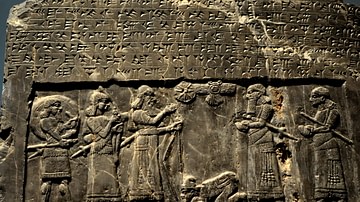
The Black Obelisk of Shalmaneser III, side A, upper register
The Assyrian king Shalmaneser III, holding a bow, receives a tribute from Sua the Gilzanean. The king faces his field marshal and another official.From Nimrud, (ancient Kalhu), near the building...

Image
Head of Senusret III
Granite head from a sphinx of the Egyptian pharaoh Senusret III with youthful features. Egypt. Middle Kingdom, 12th Dynasty, 1870 BCE. (State Museum of Egyptian Art, Munich, Germany).

Image
Tiglath Pileser III
Detail of a gypsum wall relief showing the Assyrian king Tiglath Pileser III from the South-West palace at Nimrud, Mesopotamia, modern-day Iraq, Neo-Assyrian Empire, 745-727 BCE. The king is recognizable by his long beard...

Image
Alabaster Panel from the Central Palace of Tiglath Pileser III
This alabaster panel was part of the decorative scheme of the palace of King Tiglath Pileser III (reigned 745-727 BCE) at Kalhu. The king is shown in his chariot, while in another scene above...
Image
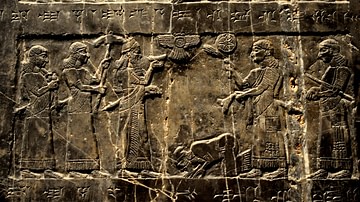
The Black Obelisk of Shalmaneser III, side A, 2nd register
The Assyrian king Shalmaneser III beneath a parasol, accepts the tribute from Iaua from the house of Humri in 841 BCE. This is king Jehu of Israel, who appears in the Bible (2 Kings 9-10). From...

Image
Tiglath-pileser III, Submission of Enemy
An alabaster bas-relief depicting the Assyrian king Tiglath-pileser III stands over a captured enemy. The cuneiform inscription describes an Assyrian campaign in Iran 744 BCE. From the central palace at Nimrud...
