
Search
Remove Ads
Advertisement

 This answer was generated by
Search Results

Definition
Timur - The Brutal Conqueror of Central Asia
Timur (1336-1405), also known as Tamerlane, Temür, or Timur Leng, was the founder of the Timurid Empire (1370-1507), which had its heartlands in modern-day Uzbekistan and capital at Samarkand. A Muslim Turkic...

Definition
Chagatai Khanate
The Chagatai Khanate (also Chaghatai, Jagatai, Chaghatay or Ca'adai, c. 1227-1363 CE) was that part of the Mongol Empire (1206-1368 CE) which covered what is today mostly Uzbekistan, southern Kazakhstan, and western Tajikistan...

Definition
Ancient Afghanistan
The ancient history of Afghanistan, a landlocked country in Central Asia, is full of fascinating cultures, from early nomadic tribes to the realms of Achaemenid Persia, the Seleucids, the Mauryans, the Parthians, and Sasanians...

Image
Tomb of Timur, Samarkand
The Gūr-i Mir, the restored tomb of Timur (1336-1405), also known as Tamerlane, in Samarkand, Uzbekistan. Timur founded the Timurid Empire (1370-1507) which spread across Central Asia.

Article
Ibn Sina, Biruni, and the Lost Enlightenment
Ibn Sina and Biruni were two of the most outstanding thinkers to have lived between ancient Greece and the European Renaissance. These two giants of a lost era of enlightenment were born in Central Asia...

Image
Building the Transcaspian Railway
An engraving showing the construction of the Russian-backed Transcaspian railway in the 1880s. Britian regarded the railway as a threat to British India during the Great Game.

Definition
Mongol Empire
The Mongol Empire (1206-1368) was founded by Genghis Khan (r. 1206-1227), first Great Khan or 'universal ruler' of the Mongol peoples. Genghis forged the empire by uniting nomadic tribes of the Asian steppe and creating a devastatingly...

Definition
Genghis Khan
Genghis Khan (aka Chinggis Khan) was the founder of the Mongol Empire which he ruled from 1206 until his death in 1227. Born Temujin, he acquired the title of Genghis Khan, likely meaning 'universal ruler’, after unifying the Mongol...
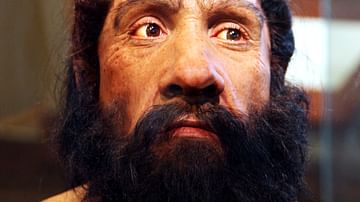
Definition
Neanderthal
Neanderthals are an extinct group of fossil humans that appeared in Western Eurasia in the mid-Middle Pleistocene and shared the stage with the first modern humans arriving in Europe from around 45,000 years ago, before disappearing...

Definition
Ögedei Khan
Ogedei Khan (aka Ogodei) ruled the Mongol Empire from 1229 to 1241. He was the third son of Genghis Khan (r. 1206-1227), the empire's founder. Ogedei's accomplishments included creating a new capital at Karakorum, establishing a system...
