
Search
Remove Ads
Advertisement
Search Results

Definition
Battle of the Little Bighorn
The Battle of the Little Bighorn (25-26 June 1876) is the most famous engagement of the Great Sioux War (1876-1877). Five companies of the 7th Cavalry under Lt. Colonel George Armstrong Custer (l. 1839-1876) were wiped...

Article
Manabozho Tales
Manabozho tales are the stories of the trickster figure and culture hero of the Ojibwe (Ojibway/Chippewa) and other Algonquin Native American nations of present-day northern United States and southeast Canada. Manabozho is a supernatural...

Definition
Tamahay (Eastman's Biography)
Tamahay (Tahama, Tamaha, "Pike", l. c. 1776-1864) was a Mdewakanton Dakota Sioux guide and scout who sided with the Americans against the British during the War of 1812. He was a famous advocate of the American cause...

Definition
Gilbert du Motier, Marquis de Lafayette
Marie-Joseph Paul Yves Roch Gilbert du Motier, Marquis de La Fayette (l. 1757-1834), more commonly known in the United States as simply Lafayette, was a French aristocrat, military officer, and politician. He...

Definition
Missouri Compromise
The Missouri Compromise of 1820 was an effort by the US Congress to resolve a sectional dispute between the 'free states' of the North and the 'slave states' of the South. Hoping to hinder the westward expansion of slavery...
Article
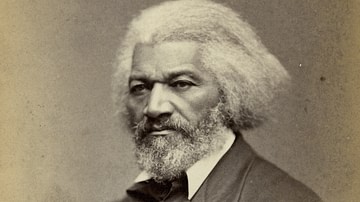
What to the Slave is the Fourth of July? - Frederick Douglass' Challenge to America
"What, to the Slave, is the Fourth of July?" is Frederick Douglass' masterwork of oration, delivered on 5 July 1852 at the Corinthian Hall in Rochester, New York. Also sometimes...

Definition
Frederick Douglass - American Visionary
Frederick Douglass (circa 1818-1895) was an abolitionist orator, minister, writer, editor, reformer, and statesman, who had been born a slave in Maryland, escaped to New York at around the age of 20, and became...

Definition
James Monroe - The Last Founding Father & the Era of Good Feelings
James Monroe (1758-1831) was an American statesman who served as the fifth president of the United States (1817-1825). The fourth president to belong to the so-called 'Virginia Dynasty'...

Definition
Alexander Hamilton
Alexander Hamilton (1755/57-1804) was a lawyer and politician, often recognized as a Founding Father of the United States. He served as George Washington's aide-de-camp during the American Revolution, before going on to become...

Definition
Narmer
Narmer (c. 3150 BCE) was the first king of Egypt who unified the country peacefully at the beginning of the First Dynastic Period (c. 3150 - 2613 BCE). He has also, however, been cited as the last king of the Predynastic Period (c. 6000...
