
Search
Did you mean: Thor?
Remove Ads
Advertisement
Search Results

Definition
Louis XVI of France
Louis XVI (l. 1754-1793) was the last king of France (r. 1774-1792) before the monarchy was abolished during the French Revolution (1789-99). An indecisive king, his attempts to navigate France through the crises of the 1780s...

Definition
Berthe Morisot
Berthe Morisot (1841-1895) was a French impressionist painter. She was admired by fellow artists, had multiple works exhibited by the Paris Salon, and had her paintings shown in seven of the eight independent impressionist exhibitions...

Definition
Frédéric Chopin
Frédéric Chopin (1810-1849) was a Polish composer and virtuoso noted for his solo piano music. Chopin's work helped make the piano the most popular musical instrument of the 19th century. One of the great composers of Romantic...

Definition
Alchemy
Alchemy is an ancient practice aimed at recreating precious substances using recipes and transformative materials such as the philosopher's stone. Alchemists believed that materials like gold, silver, gems, and purple dye could be recreated...

Article
Roman Daily Life
From the early days of the Roman Republic through the volatile reigns of such ignoble emperors as Caligula, Nero, and Commodus, the Roman Empire continued to expand, stretching its borders to encompass the entire Mediterranean...
Article
Ancient Roman Family Life
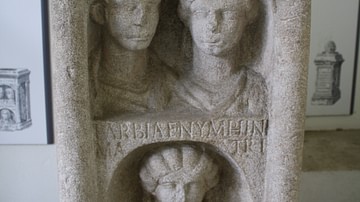
Whether there was a king, a consul, or an emperor that stood supreme over Rome and its territories, the one constant throughout Roman history was the family. Like many earlier societies, the family was the fundamental...

Article
Medieval Knights: 12 of the Best
The knights of medieval Europe were meant to be the finest fighting men of their age, even more important, they were expected to be pure in thought and deed, as exemplified in the chivalrous code which they (usually...

Article
Education in the Elizabethan Era
Besides the traditional option of private tuition, Elizabethan England (1558-1603 CE) offered formal education to those able to pay the necessary fees at preparatory schools, grammar schools, and universities. There...

Article
Constantine’s Conversion to Christianity
Constantine I (Flavius Valerius Constantinus) was Roman emperor from 306-337 CE and is known to history as Constantine the Great for his conversion to Christianity in 312 CE and his subsequent Christianization...

Article
Hellenistic & Roman Agora of Athens
Pericles’ agora of Athens flourished under Macedonian control. After Macedon was defeated by Rome, the Romans added to the district even before Greece was taken as a province and more so afterwards. The Roman version...
