
Search
Remove Ads
Advertisement
Search Results

Definition
Tsar
Tsar (also czar) is a Slavic term derived from the Latin caesar. Ivan III (Ivan the Great) (r. 1462-1505) was the first Russian ruler to begin using the title of tsar during his reign instead of the title Grand Prince of Moscow. His grandson...

Article
Reforms of Catherine the Great
Catherine II of Russia (Catherine the Great) was the empress regent of Russia from 1762 to 1796. During the mid-18th century, Russia was still regarded as culturally behind compared to Western European countries. However...

Article
The Causes of WWI
The origins of the First World War (1914-18) are many and varied, with some even dating back several decades, but a political assassination in the Balkans in the summer of 1914 was the spark that blew up Europe's political powder...

Article
The Reforms of Peter the Great
Peter I of Russia (Peter the Great, l. 1672-1725) was the Tsar of Russia from 1682 to 1721 and the Emperor of Russia from 1721-1725. The lasting impression of Peter's long reign is the significant changes he brought...
Definition
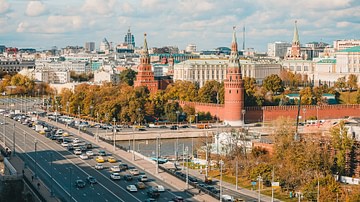
Kremlin
The Kremlin is a fortified complex located in the centre of Moscow, Russia, which is made up of towers, high walls, palaces, and cathedrals. Construction of the Kremlin began as early as the 12th century. As one of Russia's most famous...

Definition
Treaty of Brest-Litovsk
The Treaty of Brest-Litovsk, signed on 3 March 1918, outlined the harsh conditions under which the crumbling Russian Empire withdrew from the First World War (1914-18). Negotiated by Vladimir Lenin (1870-1924), the leader...

Collection
Russia in Revolution 1905-17
In the early years of the 20th century, the Russian Empire, ruled by Tsar Nicholas II (reign 1894-1917), faced increasing unrest from within by all sections of society. The peasantry, working classes, middle classes...

Definition
Russian Revolution of 1905
The Russian Revolution of 1905 challenged the absolute power of Tsar Nicholas II (reign 1894-1917) as ruler of the Russian Empire. Bloody Sunday in 1905 started the year disastrously for the tsar when soldiers fired upon...

Article
Causes of the Russian Revolution of 1917
There were many causes behind the Russian Revolution of 1917, ranging from the unpopular authoritarian rule of Tsar Nicholas II (reign 1894-1917) to the radical mobilisation of the working class, who wanted...

Definition
Russian Civil War - The Failed Fightback Against Bolshevism
The Russian Civil War (1917-22) began shortly after the Bolshevik Revolution of November 1917. The Bolsheviks (the Reds) immediately found themselves in conflict with various opposition forces...
