
Search
Remove Ads
Advertisement
Search Results

Definition
Leo VI
Leo VI was emperor of the Byzantine empire from 886-912 CE. He was the second emperor of the Macedonian dynasty and is sometimes known as “Leo the Wise” in reference to his prolific literary output which ranged from orations to law codes...

Definition
Nikephoros I
Nikephoros I ruled as emperor of the Byzantine Empire from 802 to 811 CE. A former finance minister who did much to improve the state economy, Nikephoros was not particularly popular with the empire's overtaxed peasants and overregulated...

Definition
Eleanor of Aquitaine
Eleanor of Aquitaine (l. c. 1122-1204 CE) was one of the most impressive and powerful figures of the High Middle Ages (1000-1300 CE) – male or female – whose influence shaped the politics, art, medieval literature, and perception...

Definition
Michael IV the Paphlagonian
Michael IV the Paphlagonian was Byzantine emperor from 1034 to 1041 CE. He had an affair with Empress Zoe, then married her and was crowned emperor after the death of her first husband, Romanos III. He ran a competent...

Definition
Childeric I
Childeric I (r. c. 458-481) was a late antiquity king of the Salian Franks during the period of the fall of the Western Roman Empire. Childeric's reign solidified the Salians as a dominant Frankish tribe and helped pave the way for...

Definition
Vasco da Gama
Vasco da Gama (c. 1469-1524) was a Portuguese navigator who, in 1497-9, sailed around the Cape of Good Hope in southern Africa and arrived at Calicut (now Kozhikode) on the south-west coast of India. This was the first direct voyage...

Definition
Ilkhanate
The Ilkhanate (or Ilqanate, 1260-1335 CE) was that part of the Mongol Empire (1206-1368 CE) which mostly covered what is today Iran and parts of Turkmenistan, Turkey, Iraq, Armenia, Afghanistan, and Pakistan. Established by the Mongol...
Definition
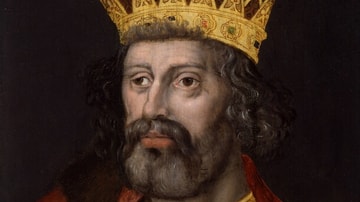
Edward I of England
Edward I of England reigned as king from 1272 to 1307 CE. Edward succeeded his father Henry III of England (r. 1216-1272 CE) and was known as 'Longshanks' for his impressive height and as 'the Hammer of the Scots' for his repeated...

Definition
Parthian Culture
Stretching between China and India in the east to the Mediterranean in the west, Parthia ruled over one of the widest expanses of empire in its time and Parthian culture flourished for 500 years (247 BCE to 224 CE). While known...

Definition
Stone of Scone
The Stone of Scone (Gaelic: Lia Fail), also known as the Stone of Destiny or Coronation Stone, is a block of sandstone associated with the coronation ceremonies of the medieval monarchs of Scotland. These ceremonies were held at...
