
Search
Did you mean: Timur?
Remove Ads
Advertisement
Search Results

Article
The Art of the Han Dynasty
The art of the Han dynasty (206 BCE - 220 CE) of ancient China is characterised by a new desire to represent everyday life and the stories from history and mythology familiar to all. The arts were fuelled both by a political stability with...

Article
The Death of David 'Davy' Crockett at the Alamo - José Enrique de la Peña's Account of the Surrender
The death of David 'Davy' Crockett at the Battle of the Alamo (6 March 1836) has been understood as a heroic last stand at least since 1880 when Texan historian Reuben M. Potter dismissed eyewitness accounts that Crockett had surrendered...

Article
The Anglo-German Arms Race - Riding the Waves to WWI
The pre-First World War arms race between Britain and Germany was fuelled by Britain's desire to protect its empire, Germany's desire to build an empire, and a general atmosphere of suspicion amongst the great powers, which led to the formation...

Article
The Nerge: Hunting in the Mongol Empire
The peoples of the Mongol Empire (1206-1368 CE) were nomadic, and they relied on hunting wild game as a valuable source of protein. The Asian steppe is a desolate, windy, and often bitterly cold environment, but for those Mongols with sufficient...

Article
Armour in Ancient Chinese Warfare
With zinging arrows, powerful crossbow bolts, stabbing swords, and swinging axes all a staple feature of the Chinese battlefield, it is not surprising that soldiers sought to protect themselves as best they could with armour and shields...
Article
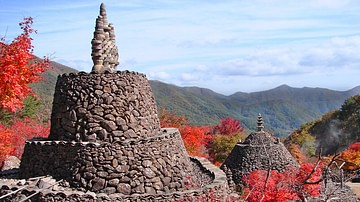
Shamanism in Ancient Korea
Shamanism was widely practised in Korea from prehistoric times right up to the modern era. It is a belief system which originated in north-east Asian and Arctic cultures, and although the term shamanism has since acquired a wider meaning...

Article
The Ajanta Caves
The 30 caves at Ajanta lie to the north of Aurangabad in the Indhyadri range of Western Ghats. The caves, famous for their temple architecture and many delicately drawn murals, are located in a 76 m high, horseshoe-shaped escarpment overlooking...

Article
Elephants in Hellenistic History & Art
Elephants were thought of as fierce and frightful monsters in antiquity, very real though rarely seen until the Hellenistic period. They were deployed on the battlefield to strike terror into the enemy, however, since fear was considered...

Article
Pigs in Ancient China
Pigs (sometimes called “suids” of the suidae family) have long played an important part in Chinese culture. Pigs symbolize good fortune and happiness as they seem to live a care-free existence and have a long relationship with the humans...

Article
8 Sonnets and Songs by William Shakespeare
The literary works of William Shakespeare (l. c. 1564-1616) are often regarded as some of the most important in the English language. Alongside his famous plays, he also wrote poems, including 154 sonnets. Included here are six of the best-known...
