
Search
Did you mean: Timur?
Remove Ads
Advertisement
Search Results

Definition
Tarentum
Tarentum (Taras, modern Taranto), located on the southern coast of Apulia, Italy, was a Greek and then Roman city. Controlling a large area of Magna Graecia and heading the Italiote League, Tarentum, with its excellent harbour, was a strategically...
Definition
Devi
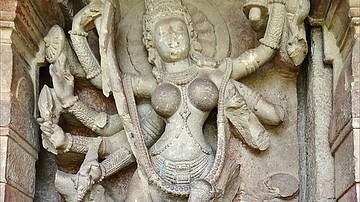
Devi, also known as Mahadevi or 'Great Goddess', is an all-embracing Mother Goddess first worshipped in India in Prehistoric times. In the Vedic period, she was assimilated into the Hindu pantheon and so came to represent the female energy...
Definition
Scythian Art
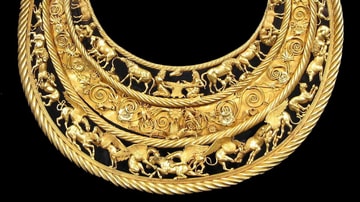
Scythian art is best known for its 'animal art.' Flourishing between the 7th and 3rd centuries BCE on the steppe of Central Asia, with echoes of Celtic influence, the Scythians were known for their works in gold. Moreover, with the recent...

Definition
Ajanta
Approximately 67 miles (107 km) to the north of Aurangabad in the Indhyadri range of Western Ghats lie the caves of Ajanta. The 30 caves, famous for their early Buddhist temple architecture and many delicately drawn murals, are located in...
Definition
Ryoanji
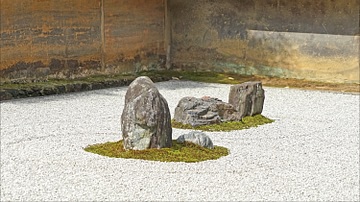
Ryoanji (Ryōan-ji) is a Zen Buddhist temple in Kyoto, Japan which is today most famous for its Zen rock garden with its enigmatic arrangement of stones. Founded in the 15th century CE, the temple is one of the most visited tourist spots in...

Article
Religion in Ancient China
Religious practices in ancient China go back over 7,000 years. Long before the philosophical and spiritual teachings of Confucius and Lao-Tzu developed or before the teachings of the Buddha came to China, the people worshipped personifications...

Article
Chariots in Ancient Chinese Warfare
The chariot was used in Chinese warfare from around 1250 BCE but enjoyed its heyday between the 8th and 5th century BCE when various states were constantly battling for control of China. Employed as a status symbol, a shock weapon, to pursue...

Article
Most Popular Gods & Goddesses of Ancient China
There were over 200 gods and goddesses worshipped throughout ancient China, but if one were to count every deity or spirit, the number would be over 1,000. Each town, village, city, field, farm, and sometimes even separate plot in a graveyard...

Article
The Dragon in Ancient China
Dragons appear in the mythology of many ancient cultures but nowhere else in the world was the creature quite so revered as in China. There, in marked contrast to other world mythologies, the dragon was almost always seen in a positive light...

Article
Food & Drink in the Mongol Empire
The diet of the Mongols was greatly influenced by their nomadic way of life with dairy products and meat from their herds of sheep, goats, oxen, camels, and yaks dominating. Fruit, vegetables, herbs, and wild game were added thanks to foraging...
