
Search
Did you mean: Thutmose III?
Remove Ads
Advertisement
Search Results

Definition
Ancient Egyptian Vizier
The vizier in ancient Egypt was the most powerful position after that of king. Known as the djat, tjat, or tjati in ancient Egyptian, a vizier was the equivalent of the modern-day prime minister of the nation who actually...

Definition
Nefertiti
Nefertiti (c. 1370 - c. 1336 BCE) was the wife of the pharaoh Akhenaten of the 18th Dynasty of Egypt. Her name means, `the beautiful one has come' and, because of the world-famous bust created by the sculptor Thutmose (discovered in...

Definition
Mitanni
The Kingdom of Mitanni, known to the people of the land, and the Assyrians, as Hanigalbat and to the Egyptians as Naharin and Metani, once stretched from present-day northern Iraq, down through Syria and into Turkey and was among the...

Definition
Deir el-Medina
Deir el-Medina is the modern Arabic name for the worker's village (now an archaeological site) which was home to the artisans and craftsmen of Thebes who built and decorated the royal tombs in the nearby Valley of the Kings and...
Definition
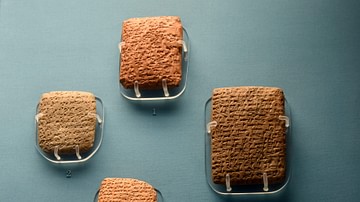
Amarna Letters
The Amarna Letters are a body of 14th-century BCE correspondence exchanged between the rulers of the Ancient Near East and Egypt. They are perhaps the earliest examples of international diplomacy while their most common subjects...

Definition
Ancient Jordan
Jordan is a country in the Near East bordered by Israel, Syria, Iraq, and Saudi Arabia. The country's name comes from the Arabic Al Urdun, referencing a fortified site but also meaning "prominence", though various sources also...

Definition
Senusret III - Greatest Egyptian Monarch of the Middle Kingdom
Senusret III (circa 1878-1839 BCE, also known as Senwosret III, Sesostris III) was the 5th king of the 12th Dynasty of the Middle Kingdom of Egypt (2040-1782 BCE). His reign is often considered...

Video
The History of Egypt: The 18th Dynasty
After defeating the Hyksos in 1500 B.C.E., under the reign of Thutmose II, the Egyptian elite faced a crisis. Several factions developed with differing opinions over how Egypt should conduct itself now that they...

Article
Ancient Egyptian Taxes & the Cattle Count
The gods of ancient Egypt freely gave their bounty to the people who worked the land, but this did not exempt those farmers from paying taxes on that bounty to the government. Egypt was a cashless society until...

Article
Spiritual Defense - Execration Rituals in Ancient Egypt
Magic was an integral aspect of life in ancient Egypt. The world was created through the power of heka (magic) as Atum stood on the primordial mound of the ben-ben in the middle of the endless waters...
