
Search
Did you mean: Thanatos?
Remove Ads
Advertisement
Search Results

Definition
Lighthouse of Alexandria
The Lighthouse of Alexandria was built on the island of Pharos outside the harbour of Alexandria, Egypt c. 300 - 280 BCE, during the reigns of Ptolemy I and II. With a height of over 100 metres (330 ft), the lighthouse...
Definition
Philippi
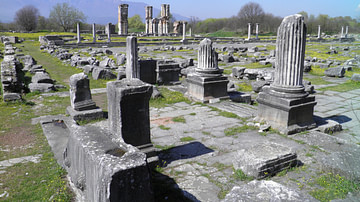
Philippi was an important city in eastern Macedon which flourished in the Hellenistic, Roman, and Byzantine Periods. Situated between the Strymon and Nestos rivers, the city was valued in antiquity for its nearby gold mines. Site of...

Definition
Dionysos
Dionysos (Roman name: Bacchus, also known as Dionysus) was the ancient Greek god of wine, merriment, and theatre. Being the bad boy of Mt. Olympus, Dionysus was perhaps the most colourful of the Olympian Gods. Son of Zeus In Greek...

Definition
Ancient Israelite Art
Ancient Israelite art traditions are evident especially on stamps seals, ivories from Samaria, and carvings, each with motifs connecting it to more general artistic traditions throughout the Levant. Ancient Israel, and therefore...

Definition
Phoenician Colonization
The prosperity of Phoenician cities such as Tyre, Sidon, and Byblos was based on trade, and it was the search for new commodities and new markets which resulted in the Phoenicians branching out from the narrow coastal strip...

Definition
Cyclades
The Cyclades are a group of islands in the southern Aegean situated between the Greek mainland and Turkey. The name was coined in the Archaic period as the islands form an approximate circle (kyklos) around the central and most sacred...

Definition
Paros
Paros is an island in the Cyclades group in the central Aegean. It is the third largest island of the Cyclades and its position on important sea routes between mainland Greece and the coast of Asia Minor made it an important centre from...

Definition
Cimon
Cimon (c. 510 – 450 BCE) was an Athenian statesman and, as strategos, frequent commander of the Athenian fleet when the city was at the height of its power. He won military glory by defeating Spartan rival Pausanias and then the Persians...

Article
Trade in Ancient Greece
Trade was a fundamental aspect of the ancient Greek world and following territorial expansion, an increase in population movements, and innovations in transport, goods could be bought, sold, and exchanged in one part of...

Article
Food & Agriculture in Ancient Greece
The prosperity of the majority of Greek city-states was based on agriculture and the ability to produce the necessary surplus which allowed some citizens to pursue other trades and pastimes and to create a quantity...
