
Search
Remove Ads
Advertisement
Search Results

Image
Votive Plaque Dedicating a Property to Nabu's Temple
Bronze plaque in the form of an amulet, inscribed with cuneiform inscriptions. The figures of four deities were incised above the inscriptions. Marduk holds on a necklace and stands on a dragon while...

Image
Facade of the Temple of Ninmah at Babylon
The facade of Ninmah (Ninhursag, Damgalnuna) Temple at the ancient city of Babylon, Iraq, reing of Nebuchadnezzar II, 6th century BCE. Ninmah was a mother goddess in ancient Mesopotamia. Most of the walls were...

Image
Peripteral Temple at Stratonicea
The peripteral temple at Stratonicea built in the Ionic order. It it is situated on the upper terrace above the cavea of the theatre and was probably dedicated to the Imperial cult of Augustus and Rome.

Image
Temple of Athena Lindia - Rhodes
At the top of the Lindos Acropolis, on the island of Rhodes, are the ruins of the 4th century BCE temple, dedicated to the goddess Athena Lindia, as well as the propylaea, monumental colonnade, entrance to the religious...
Image
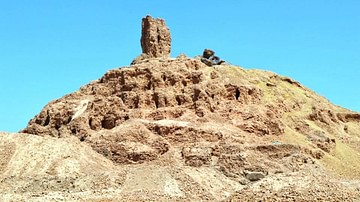
Ziggurat and Temple of God Nabu, Borsippa
The temple to Nabu at Borsippa was destroyed in 484 BCE during the suppression of a revolt against the Achaemenid king Xerxes.
Modern Biris Namrud, Babil Governorate, Iraq.

Image
A door socket from Anu-Adad Temple
The cuneiform inscriptions on this door socket mention the name of Shalmaneser III, King of Assyria (858-824 BCE). The king dedicated the stone to the gods Anu and Adad for his life and the well-being of his people...

Image
Temple of Bacchus, Baalbek
Detail of the cella of the Bacchus temple in Baalbek, Lebanon which dates to the end of the 2nd century CE.

Image
Doric Temple of Zeus, Nemea
The Doric temple of Zeus, Nemea. c. 330 BCE.
Image
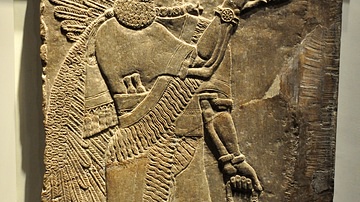
Apkallu from the Temple of Ninurta
This gypsum wall relief depicts an eagle-headed and winged man; this is a protective spirit or Apkallu. He holds a bucket and a cone, and wears an elaborate dress and accessories as well as sandals. Neo-Assyrian...
Image
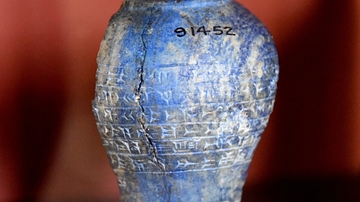
Portion of a Lapis Lazuli Head-Mace from the Temple of Ninurta
This fragment of a lapis lazuli Head-mace was inscribed with six lines of cuneiform inscriptions. The name of Ashurnasirpal II (reigned 884-859 BCE) was mentioned in this dedicatory text. Neo-Assyrian...
