
Search
Did you mean: Armenian Mythology?
Remove Ads
Advertisement
Search Results

Definition
Astarte
Astarte is the Canaanite/Phoenician goddess of love, sex, war, and hunting who developed from the Mesopotamian deity Inanna/Ishtar. She is usually associated with the storm god Baal but seems to have been much more popular. She traveled...

Definition
Aztec Art
The Aztec culture, centred at the capital of Tenochtitlan, dominated most of Mesoamerica in the 15th-16th centuries. With military conquest and trade expansion, the art of the Aztecs also spread, helping the Aztec civilization achieve...

Definition
Roman Art
The Romans controlled such a vast empire for so long a period that a summary of the art produced in that time can only be a brief and selective one. Perhaps, though, the greatest points of distinction for Roman art are its very diversity...

Definition
Hyperborea
In Greek mythology, Hyperborea was the land located to the far north of the known world and it was so remote it was considered even beyond the North Wind. There a legendary race known as the Hyperboreans lived and worshipped the sun...
Definition
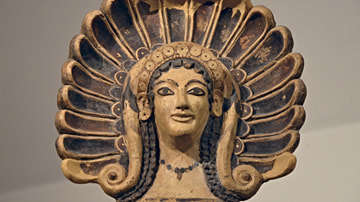
Etruscan Pottery
Etruscan pottery, produced over five centuries, was nothing if not varied. Indigenous wares such as the glossy black bucchero were made alongside red- and black-figure pottery imitating, yet modifying those produced in the Greek...
Definition
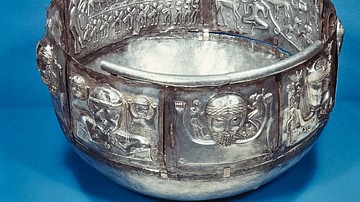
Gundestrup Cauldron
The Gundestrup Cauldron is a gilded silver bowl found in Gundestrup in Denmark in 1891 CE. It was likely made in the Balkans, perhaps in the 1st century BCE, and shows a clear influence from Celtic art and mythology, even if...

Definition
Etruscan Art
The art of the Etruscans, who flourished in central Italy between the 8th and 3rd century BCE, is renowned for its vitality and often vivid colouring. Wall paintings were especially vibrant and frequently capture scenes of Etruscans...

Definition
Hera
Hera (Roman name: Juno) is the wife of Zeus and queen of the ancient Greek gods. Hera represented the ideal woman, was the goddess of marriage and the family, and protectress of women in childbirth. Hera was always faithful to Zeus but...

Definition
Minerva
Minerva was the Roman goddess of wisdom, medicine, commerce, handicrafts, poetry, the arts in general, and later, war. In many ways similar to the Greek goddess Athena, she had important temples in Rome and was patron of the Quinquatras...

Definition
Orpheus
Orpheus is a figure from ancient Greek mythology, most famous for his virtuoso ability in playing the lyre or kithara. His music could charm the wild animals of the forest, and even streams would pause and trees bend a little closer...
