
Search
Remove Ads
Advertisement
Search Results

Definition
Buddhism
Buddhism is a non-theistic religion (no belief in a creator god), also considered a philosophy and a moral discipline, originating in the region of modern-day India in the 6th and 5th centuries BCE. It was founded by the sage Siddhartha...

Definition
Tigranocerta
Tigranocerta (Tigranakert) was a city in the southwest of ancient Armenia founded and made capital by Tigranes the Great in 83 BCE. Famous for its riches and fine buildings, as well as its mix of Hellenistic and Persian culture...

Definition
Crusader States
The Crusader States (aka the Latin East or Outremer) were created after the First Crusade (1095-1102) in order to keep hold of the territorial gains made by Christian armies in the Middle East. The four small states were the Kingdom...

Definition
Kilwa
Kilwa, an island located off the coast of East Africa in modern-day southern Tanzania, was the most southern of the major Swahili Coast trading cities that dominated goods coming into and out of Africa from and to Arabia, Persia, and...

Article
Pericles & the Restoration of the Athenian Agora
The agora of Athens developed from the 6th century BCE until it was destroyed in the Persian invasion of 480 BCE. Afterwards, the statesman Pericles (l. 495-429 BCE) used funds from the Delian League...

Definition
Urartu Art
The art produced by the Urartu civilization, which flourished in ancient Armenia, eastern Turkey, and northwestern Iran from the 9th to 6th century BCE, is best seen in bronze figurines of deities, bronze cauldrons with animal and...

Definition
Sparta
Sparta was one of the most important city-states in ancient Greece and was famous for its military prowess. The professional and well-trained Spartan hoplites with their distinctive red cloaks and long hair were probably the best and...
Article
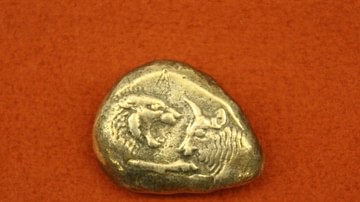
The Importance of the Lydian Stater as the World's First Coin
The Lydian Stater was the official coin of the Lydian Empire, introduced before the kingdom fell to the Persian Empire. The earliest staters are believed to date to around the second half of...

Article
The Horse-rider Theory in Ancient Japan
The 'horse-rider theory' is a controversial proposal that Japan was conquered around the 4th or 5th century CE by a culture from northern Asia to whom the horse was especially important. Although archaeological...

Article
Depictions of India in Ancient Literature
Herodotus (484 BCE – c. 425 BCE) has been called the Father of History since he was the first historian known to collect his materials in detail, test their accuracy to a certain extent and arrange them in...
