
Search
Remove Ads
Advertisement
Search Results

Definition
Russian Revolution of 1905
The Russian Revolution of 1905 challenged the absolute power of Tsar Nicholas II (reign 1894-1917) as ruler of the Russian Empire. Bloody Sunday in 1905 started the year disastrously for the tsar when soldiers fired upon...

Definition
Nuremberg Rally
The Nuremberg Rally, or the Reich Party Congress, was an annual event held from 1927 to 1938 in Nürnberg, Germany. Organised on a massive scale by the National Socialist Party (Nazi), these operations in pomp, ceremony, and propaganda...

Definition
Meiji Period
The Meiji period refers to the period in Japanese history from 1868 to 1912 during which the Meiji Emperor reigned. Following the overthrow of the Tokugawa shogunate in the Meiji Restoration of 1868, Japan's new leaders embarked...

Definition
Bloody Sunday in 1905 - The Massacre at the Tsar's Winter Palace
Bloody Sunday on 22 January 1905 was the massacre of peaceful and unarmed protestors by soldiers outside the Winter Palace in St. Petersburg, Russia. The crowd of workers and their families...

Definition
Paris Peace Conference - How WWI's Victors Reshaped the World
The Paris Peace Conference, held from January 1919 to January 1920 and attended by the victorious Allied powers, debated and agreed the terms of the peace settlement that formally ended the...

Definition
Beer Hall Putsch
The Beer Hall Putsch or Munich Putsch was a failed attempt by the German National Socialist (Nazi) Party to seize power, first of the Bavarian and then the German federal government on 8-9 November 1923. The coup, led by Adolf...
Definition
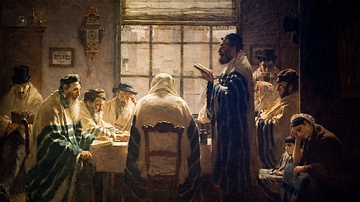
Tallit
The tallit is a garment worn by those of Jewish faith as a symbol of communal solidarity and devotion to their god. The foundation for modern Jewish socio-religious concepts is the Tanakh, or Hebrew bible which is also the Christian Old...

Article
Consequences of the Bolshevik Revolution
The long-term goal of the Bolsheviks, who took power by force in Russia in November 1917, was a fairer society where workers and peasants were not exploited by wealthy capitalists. The more immediate consequences...

Article
The 1918 Armistice with Germany - Allied Victory on WWI's Western Front
The armistice that ended the First World War (1914-18) on the Western Front was signed between Germany and the Allies on 11 November 1918. The guns fell silent at 11:00 a.m. that day...

Article
The Brothers Gracchi: The Tribunates of Tiberius & Gaius Gracchus
Tiberius and Gaius Gracchus were a pair of tribunes of the plebs from the 2nd century BCE, who sought to introduce land reform and other populist legislation in ancient Rome. They were both...
