
Search
Remove Ads
Advertisement
Search Results

Definition
Second Crusade
The Second Crusade (1147-1149) was a military campaign organised by the Pope and European nobles to recapture the city of Edessa in Mesopotamia which had fallen in 1144 to the Muslim Seljuk Turks. Despite an army of 60,000 and...

Definition
Emperor Zeno
Zeno was Byzantine emperor from 474 until 491 CE. An ethnic Isaurian, Zeno was repeatedly criticized as an outsider during his reign, which was full of rebellions and attacks by the Ostrogoths. He is best known for his failed attempt...

Definition
Manuel I Komnenos
Manuel I Komnenos was emperor of the Byzantine Empire from 1143 to 1180 CE. Manuel continued the ambitious campaigns of his grandfather Alexios I and father John II to aggressively expand the boundaries of his empire. Manuel...

Definition
Anastasios I
Anastasios I ruled the Byzantine empire from 491 to 518 CE. Although his tax and monetary reforms were both popular and successful, the emperor could not repair the damaging split in the Christian Church created by his predecessors...

Article
Artillery in Medieval Europe
Artillery weapons in medieval Europe included the mounted crossbow (ballista) and single-arm torsion catapult (mangonel), both similar to ancient Roman machines. As armies battled further afield such as in the Byzantine...

Definition
Michael IV the Paphlagonian
Michael IV the Paphlagonian was Byzantine emperor from 1034 to 1041 CE. He had an affair with Empress Zoe, then married her and was crowned emperor after the death of her first husband, Romanos III. He ran a competent...

Video
The City of Walls: Constantinople - Lars Brownworth
The world owes much of its cultural legacy to Constantinople's walls. When Constantinople was under seige by neighboring enemies, the Roman city's elaborate system of moats, outer walls, and inner walls...

Image
Map of the Siege of Toulon 18-19 Dec. 1793
This map illustrates the final stage of the Siege of Toulon (August 28–December 19, 1793), one of the early defining campaigns of the French Revolutionary Wars. The operation not only secured a vital naval...
Definition
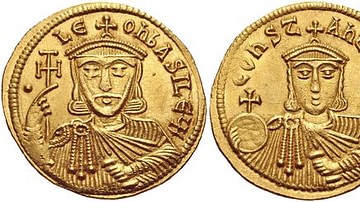
Leo V the Armenian
Leo the V the Armenian was emperor of the Byzantine Empire from 813 to 820 CE. He was of Armenian descent and the last ruler of the Isaurian dynasty which had been founded by Leo III (r. 717-741 CE). The emperor's reign, after...

Image
Carthage Under Siege
An artist's impression of what the Roman siege of Carthage may have looked like during the Third Punic War, 149-146 BCE.
