
Search
Remove Ads
Advertisement
Search Results

Definition
George Washington - Father of His Country
George Washington (1732-1799) was an American military officer and statesman who led the Continental Army to victory during the American Revolutionary War (1775-1783) and served as the first president of the...

Definition
Battle of Valmy
The Battle of Valmy was a stunning French victory over a Prussian-led coalition army on 20 September 1792, during the French Revolutionary Wars (1792-1802). Although the battle was little more than a skirmish, it halted the coalition's...

Definition
William Howe
Sir William Howe (1729-1814) was a British military officer and politician, most notable for his role as commander-in-chief of the British army during the initial years of the American Revolutionary War (1775-1783). Despite several...
Definition
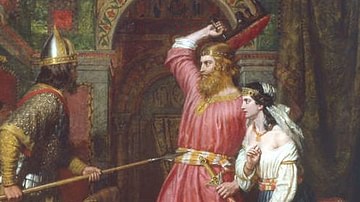
Alboin
Alboin (r. 560-572 CE) was a king of the Lombards who led his people into Italy and founded the Kingdom of the Lombards which lasted from 568-774 CE. His father was Audoin, King of the Lombards, and his mother Queen Rodelinda. He was...

Definition
Second Continental Congress
The Second Continental Congress was the body of delegates that governed the Thirteen Colonies and, later, the United States during the American Revolutionary War. Between its first session in May 1775 and its disbandment...

Definition
Treaty of Paris of 1783
The Treaty of Paris, signed on 3 September 1783 by representatives from Great Britain and the United States, was the peace agreement that formally ended the American Revolutionary War (1775-1783) and recognized the United...

Definition
Anglo-Zulu War - Britain's Invasion of Zululand
The Anglo-Zulu War of 1879 saw British-led armies invade the Zulu Kingdom in Southern Africa as part of a wider plan to unify various territories into a single British-controlled state. Despite their spectacular...

Definition
English Civil Wars
The English Civil Wars (1642-1651) witnessed a bitter conflict between Royalists ('Cavaliers') and Parliamentarians ('Roundheads'). The Royalists supported first King Charles I of England (r. 1625-1649) and then his son Charles...

Article
The Hundred Years' War: Consequences & Effects
The Hundred Years' War was fought intermittently between England and France from 1337 to 1453 CE and the conflict had many consequences, both immediate and long-lasting. Besides the obvious death and destruction...

Article
1453: The Fall of Constantinople
The city of Constantinople (modern Istanbul) was founded by Roman emperor Constantine I in 324 CE and it acted as the capital of the Eastern Roman Empire, or Byzantine Empire as it has later become known, for well...
