
Search
Did you mean: Shinto?
Remove Ads
Advertisement
Search Results

Article
The Royal Macedonian Tombs at Vergina
Excavations at Vergina in northern Greece in the late 1970s CE unearthed a cluster of tombs thought to be the burial site of Philip II (r. 359-336 BCE), the father of Alexander the Great (r. 336-323 BCE), with...

Article
The Greek Phalanx
One of the most effective and enduring military formations in ancient warfare was that of the Greek phalanx. The age of the phalanx may be traced back to Sumeria in the 25th century BCE, through Egypt, and finally appearing in...

Article
The Ancient Celtic Pantheon
The ancient Celtic pantheon consisted of over 400 gods and goddesses who represented everything from rivers to warfare. With perhaps the exception of Lugh, the Celtic gods were not universally worshipped across Iron Age...

Article
The Sun & the Moon in Norse Myth
In Norse mythology, the Sun and the Moon appear as personified siblings pulling the heavenly bodies and chased by wolves, or as plain objects. Written sources, such as the Poetic Edda and the Prose Edda, have surprisingly...

Article
Medieval Knights: 12 of the Best
The knights of medieval Europe were meant to be the finest fighting men of their age, even more important, they were expected to be pure in thought and deed, as exemplified in the chivalrous code which they (usually...
Article
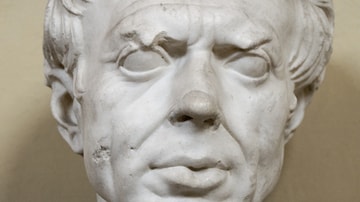
Marian Reforms
The Marian Reforms were a set of the reforms introduced to the Roman army in the late 2nd century BCE by Roman general and politician Gaius Marius (157-86 BCE). Through these reforms, the Roman army was transformed from a semi-professional...

Article
Weapons in Ancient Egypt
The ancient Egyptian military is often imagined in modern films and other media as a heavily armed and disciplined fighting force equipped with powerful weapons. This depiction, however, is only true of the Egyptian army...

Article
Armour in Ancient Chinese Warfare
With zinging arrows, powerful crossbow bolts, stabbing swords, and swinging axes all a staple feature of the Chinese battlefield, it is not surprising that soldiers sought to protect themselves as best they could...

Article
Battle of Alesia
The Battle of Alesia was a decisive Roman victory in Julius Caesar's Gallic Wars in September 52 BCE. Roman commander Julius Caesar (100-44 BCE) and his legions faced a united Gallic army under the command of Vercingetorix (82-46...

Article
Battle of Friedland
The Battle of Friedland (14 June 1807) was a decisive battle of the Napoleonic Wars (1803-1815), fought by the armies of the French and Russian empires. A major French victory, Friedland caused the Russians to sue for peace...
