
Search
Remove Ads
Advertisement
Search Results

Article
The Armies of the East India Company
The East India Company (EIC) was first England's and then Britain's tool of colonial expansion in India and beyond. Revenue from trade and land taxes from territories it controlled allowed the EIC to build up its...

Article
The Lullubian Rock Relief of Darband-i Basara
History doesn't repeat itself, but it does rhyme. (Mark Twain) Darband-i Basara (the Pass of Basara) is a narrow natural gorge which transects the anticlines of the upper part of the Qaradagh Mountain...

Video
The History of the Great Mughals, Babur to Aurangzeb | 1483 - 1707
The Mughal Empire ruled parts of the Indian Subcontinent for more than three centuries. In that time, it transformed India into what it is today. The Mughals came as outsiders from Central...

Image
The Qutb Minar
Qutb Minar, photograph by Juan Ángel Piqueras, Mehrauli, South Delhi, Delhi, India, 18 August 2026. The Qutb Minar (also spelled Qutub or Qutab Minar) is the world's tallest brick minaret, rising to a height of 72.5 meters (238...
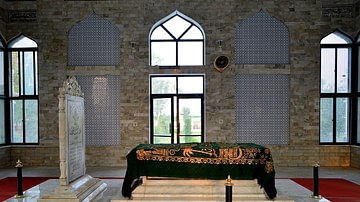
Definition
Muhammad Ghori
Shihab al-Din (also Muʿizz al-Din Muhammad ibn Sam), popularly known as Muhammad Ghori (r. 1173-1206 CE), was the Muslim ruler who laid the foundation for the subsequent Islamic ruling dynasties of India which saw its pinnacle...

Definition
Zorvanism
Zorvanism (also given as Zuvanism, Zurvanism) was a sect of the Persian religion Zoroastrianism which emerged in the late Achaemenid Empire (c. 550-330 BCE) and flourished during the Sassanian Empire (224-651 CE). It is often referenced...

Image
Map of Europe Before the Fall of Constantinople, c. 1450 - Political Europe and the Eastern Mediterranean
Around 1450 CE, Europe and the eastern Mediterranean stood at the intersection of declining medieval powers and emerging regional states. The Byzantine Empire...

Image
Mughal Decoration, Taj Mahal
A detail of the intricate decoration on the facade of the Taj Mahal, Agra, Uttar Pradesh, India. Built from 1632 by the Mughal emperor Shah Jahan as a mausoleum for his favourite wife Mumtaz Mahal. The decoration includes...
Image
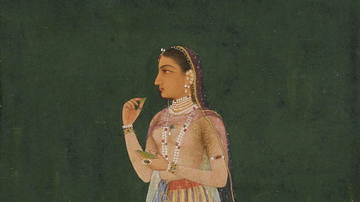
Jahanara Begum
A 1632 portrait of Jahanara Begum (1614-81), daughter of Queen Mumtaz Mahal (1593-1631) and Shah Jahan (r. 1628-1658), emperor of the Mughal Empire. (British Library, London)

Image
Wazir Khan Mosque, Lahore
Wazir Khan Mosque, Lahore, Pakistan, built between 1634 and 1641 under the reign of Mughal Emperor Shah Jahan and named after the renowned physician and later Viceroy of Punjab Hakim Ilmud Din Ansari, who was given the...
