
Search
Remove Ads
Advertisement
Search Results
Definition
Mo Ti
Mo Ti (l. 470-391 BCE, also known as Mot Tzu, Mozi, and Micius) was a Chinese philosopher of the Warring States Period (c. 481-221 BCE) associated with the Hundred Schools of Thought (different philosophical schools which established...

Definition
Narmer
Narmer (c. 3150 BCE) was the first king of Egypt who unified the country peacefully at the beginning of the First Dynastic Period (c. 3150 - 2613 BCE). He has also, however, been cited as the last king of the Predynastic Period (c. 6000...

Definition
Ancient Egyptian Literature
Ancient Egyptian literature comprises a wide array of narrative and poetic forms including inscriptions on tombs, stele, obelisks, and temples; myths, stories, and legends; religious writings; philosophical works; wisdom...

Definition
Qilin (Chinese Unicorn)
The qilin (麒麟, or simply lin 麟) is a Chinese mythical creature, frequently translated as "Chinese unicorn." While this term may suggest a one-horned creature, the qilin is often depicted with two horns. However, like the...
Definition
Punt
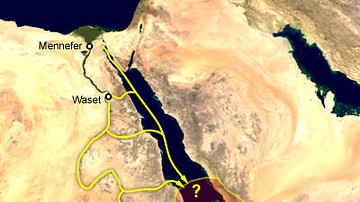
The Land of Punt was a region in Africa (most likely Somalia) referenced by inscriptions of ancient Egypt initially as a partner in trade and, later, as a semimythical country rich in resources and exotic goods. It is best known from the...
Definition
Code of Ur-Nammu - The Oldest Law Code in the World
The Code of Ur-Nammu (circa 2100-2050 BCE) is the oldest extant law code in the world. It was written by the Sumerian king Ur-Nammu (reign circa 2112-2094 BCE) or his son Shulgi of Ur (reign 2094 to...

Definition
Xunzi
Xunzi (pronounced shund-zee, l. c. 310-c. 235 BCE) was a Confucian philosopher of the Warring States Period (c. 481-221 BCE) in China. He is also known as Hun Kuang, Hsun Tzu, Xun Tzu, and Xun Kuang. Xunzi translates as Master Xun and...

Definition
Ancient Egyptian Vizier
The vizier in ancient Egypt was the most powerful position after that of king. Known as the djat, tjat, or tjati in ancient Egyptian, a vizier was the equivalent of the modern-day prime minister of the nation who actually...

Definition
Ancient Egyptian Mythology
Egyptian mythology was the belief structure and underlying form of ancient Egyptian culture from at least c. 4000 BCE (as evidenced by burial practices and tomb paintings) to 30 BCE with the death of Cleopatra VII, the...

Definition
Ancient Egyptian Burial
Egyptian burial is the common term for the ancient Egyptian funerary rituals concerning death and the soul's journey to the afterlife. Eternity, according to scholar Margaret Bunson, “was the common destination of each man...
