
Search
Remove Ads
Advertisement
Search Results

Video
All Roads Lead to Rome: The Roads of Ancient Rome
Did you know that Roman roads were dug through mountains and across rivers? This video is all about Roman roads, how they were built, and how they lasted for centuries. Roman roads were, then, the...
Image
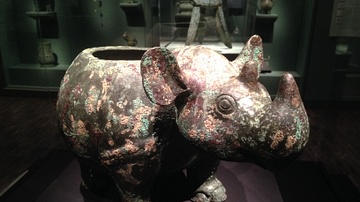
Bronze Ritual Vessel in the Shape of a Rhinoceros
This bronze ritual vessel dates to 1100 – 1050 BCE (Shang Dynasty period). Unearthed in Liangshan, Shandong, the vessel, likely used to hold wine or food, is notable for its differences from other...

Image
Obelisk at Piazza della Minerva
The obelisk standing in the Piazza della Minerva is the smallest of Rome’s obelisks and it is positioned on the back of an elephant sculpted by Gian Lorenzo Bernini (1598 – 1680 CE). The origins of this obelisk are...

Image
Slab Tomb, Meseta A
Stone slab tomb with carved sarcophagus lid at Meseta A at Alto de los Ídolos near San Agustín, Huila Department, Colombia. Created c. 1st to 10th century CE.

Image
Funerary Statues at Mesita B
Megalithic funerary statues at Mesita B near San Agustín, Huila Department, Colombia. Created c. 1st to 10th century CE.

Image
Seven-Bowl Sweetmeat Dish from Iran
Seven-bowl sweetmeat dish from Iran, 13th to 14th century. Sweetmeat dishes are notable for their infrequent presence amongst the vast array of Persian ceramic ware. Their history dates back to at least the Seljuk...
Image
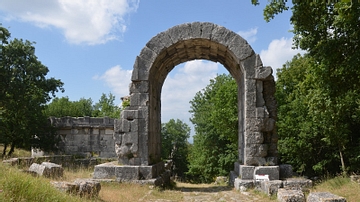
Via Flaminia at Carsulae
The Via Flaminia was constructed for military purposes by Gaius Flaminius in 220 BCE. It went through the ancient town of Carsulae (Umbria, Italy) and became its main road (cardo maximus) of which 400 metres are still visible...

Image
Funerary Statue, Mesita C
Megalithic funerary statue at Mesita C near San Agustín, Huila Department, Colombia. Created c. 1st to 10th century CE.
Image
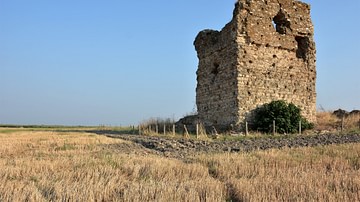
Tower of Civitate
Tower of Civitate, San Paolo di Civitate's countryside, Italy. It is one of the few ruins still visible of the medieval city where the Battle of Civitate took place on 18 June 1053.
Image
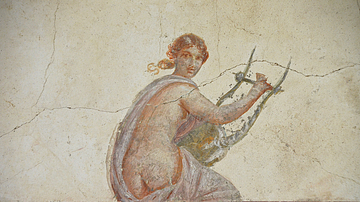
Painted Figure with Lyre
Roman fresco depicting a woman holding a lyre. Mid-1st century CE. From Room 30 of the Villa San Marco in Stabiae, Italy.
