
Search
Did you mean: Samaritans?
Remove Ads
Advertisement

 This answer was generated by
 Search Results

Image
Tomb of Timur, Samarkand
The Gūr-i Mir, the restored tomb of Timur (1336-1405), also known as Tamerlane, in Samarkand, Uzbekistan. Timur founded the Timurid Empire (1370-1507) which spread across Central Asia.

Definition
Timur - The Brutal Conqueror of Central Asia
Timur (1336-1405), also known as Tamerlane, Temür, or Timur Leng, was the founder of the Timurid Empire (1370-1507), which had its heartlands in modern-day Uzbekistan and capital at Samarkand. A Muslim Turkic...

Definition
Chagatai Khanate
The Chagatai Khanate (also Chaghatai, Jagatai, Chaghatay or Ca'adai, c. 1227-1363 CE) was that part of the Mongol Empire (1206-1368 CE) which covered what is today mostly Uzbekistan, southern Kazakhstan, and western Tajikistan...
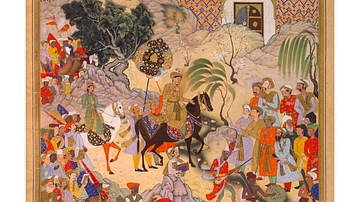
Image Gallery
A Gallery of Mughal Paintings
In this gallery, we present many fine examples of paintings from the Mughal Empire (1526-1857). Espoused and cultivated by the Mughal court, the artform married the bold styles of classical Indian miniature painting...

Definition
Mongol Empire
The Mongol Empire (1206-1368) was founded by Genghis Khan (r. 1206-1227), first Great Khan or 'universal ruler' of the Mongol peoples. Genghis forged the empire by uniting nomadic tribes of the Asian steppe and creating a devastatingly...

Definition
Genghis Khan
Genghis Khan (aka Chinggis Khan) was the founder of the Mongol Empire which he ruled from 1206 until his death in 1227. Born Temujin, he acquired the title of Genghis Khan, likely meaning 'universal ruler’, after unifying the Mongol...

Definition
Marco Polo
Marco Polo (1254-1324 CE) was a Venetian merchant and explorer who travelled to China and served the Mongol ruler Kublai Khan (l. 1214-1294 CE) between c. 1275 and 1292 CE. Polo's adventures are recounted in his own writings, The...

Image
Map of Timur’s Empire and Campaigns, 1370–1405 - The rise and the expansion of Tamerlane across Eurasia
The Timurid Empire under Timur (reign 1370–1405) emerged from the fragmented political world of the western Chagatai Khanate in Central Asia. Born near Kesh...

Definition
The Great Game - Britain and Russia's Imperial Rivalry
The Great Game describes the rivalry between the British and Russian empires through the 19th century. The game was primarily concerned with the control of certain regions in Central Asia and the...

Definition
Yurt
A yurt (ger in Mongolian) is a large circular tent made of wool felt stretched over a wooden frame used by nomadic peoples of the Asian steppe since before written records began. Yurts are especially associated with Mongol herders and...
