
Search
Remove Ads
Advertisement
Search Results
Definition
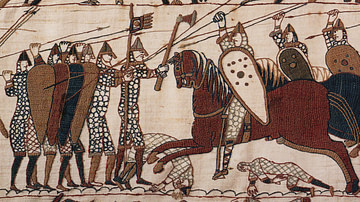
Anglo-Saxon Warfare
Anglo-Saxon warfare was characterised by frequent and violent conflicts between petty kings, which ultimately led to the rise of larger kingdoms such as the Kingdom of Mercia, the Kingdom of Northumbria, and the Kingdom of...

Definition
Mythology
Myths are a part of every culture in the world and are used to explain natural phenomena, where a people came from and how their civilization developed, and why things happen as they do. At their most basic level, myths comfort by...

Definition
Sargon of Akkad - From Gardener to King of the Four Corners of the World
Sargon of Akkad (reign 2334-2279 BCE) was the king of the Akkadian Empire of Mesopotamia, the first multinational empire in history, who united the disparate kingdoms of the region under...

Definition
Huns
The Huns were a nomadic tribe prominent in the 4th and 5th century whose origin is unknown but, most likely, they came from "somewhere between the eastern edge of the Altai Mountains and the Caspian Sea, roughly modern Kazakhstan" (Kelly...

Definition
Gupta Architecture
The Gupta Dynasty (4th-6th century) in North Central India saw the first purpose-built Hindu (and also Buddhist) temples which evolved from the earlier tradition of rock-cut shrines. Adorned with towers and elaborate carvings...

Definition
Hanji
Hanji is the name of the handmade paper produced in ancient Korea from the 1st century BCE. Made from mulberry trees its exceptional quality made it a successful export, and it was widely used not only for writing but also interior walls...

Definition
Periander
Periander was the second tyrant of Corinth (d. c. 587 BCE); Diogenes Laertius only mentions that he was eighty when he died, meaning that he was probably born c. 667 BCE. His father Cypselus (r. 657-627 BCE), from whom the short-lived...

Definition
Queen Himiko
Queen Himiko, also known as Pimiko or Pimiku (183? - 248 CE), was a 3rd-century CE ruler of the territory in ancient Japan known as Hsieh-ma-t'ai or Yamatai, later to be known as Yamato. Considered by the Chinese as the ruler of...

Definition
Temple at Uppsala
The Temple at Uppsala was a religious center dedicated to the Norse gods Thor, Odin, and Freyr located in what is now Gamla Uppsala in Sweden. It is described by the 11th-century historian Adam of Bremen as the most significant...

Definition
Joséphine de Beauharnais
Joséphine de Beauharnais (1763-1814) was a French noblewoman who was the first wife of Napoleon Bonaparte (1769-1821). She was therefore Empress of the French from 18 May 1804 until the annulment of her marriage on 10 January...
