
Search
Remove Ads
Advertisement
Search Results
Definition
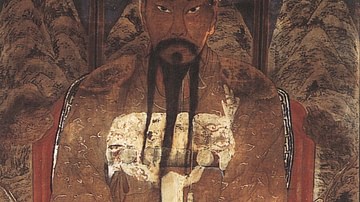
Dangun
Dangun Wanggeom (or Tangun) was the legendary founder of Gojoseon (Gochoson or Old Choson), the first Korean state which ruled northern Korea in the second half of the first millennium BCE. Gojoseon possessed the most advanced culture...

Definition
Timur - The Brutal Conqueror of Central Asia
Timur (1336-1405), also known as Tamerlane, Temür, or Timur Leng, was the founder of the Timurid Empire (1370-1507), which had its heartlands in modern-day Uzbekistan and capital at Samarkand. A Muslim Turkic...
Definition
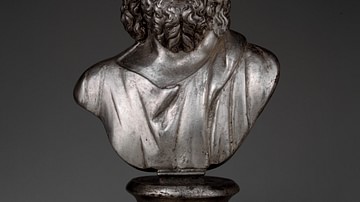
Serapis
Serapis is a Graeco-Egyptian god of the Ptolemaic Period (323-30 BCE) of Egypt developed by the monarch Ptolemy I Soter (r. 305-282 BCE) as part of his vision to unite his Egyptian and Greek subjects. Serapis’ cult later spread throughout...
Definition
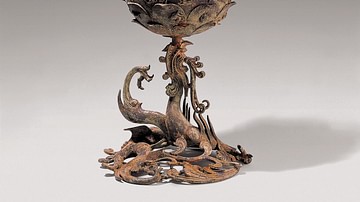
Baekje
Baekje (Paekche) was one of the Three Kingdoms which ruled over ancient Korea from the 1st century BCE to the 7th century CE. Controlling territory in the south-western part of the peninsula the kingdom was in constant rivalry with the...

Definition
Romanos IV Diogenes
Romanos IV Diogenes ruled the Byzantine Empire from 1068 to 1071 CE. He was a military emperor, and his policies and campaigns served to shore up Byzantine defenses against the Seljuk Turks. However, in the aftermath of the...

Definition
Lumbini
Lumbini is a village, archaeological site, and place of pilgrimage honored as the birthplace of Siddhartha Gautama (the Buddha, l. c. 563-483 BCE) located in modern-day Rupandehi District of Nepal, Province 5, near the Indian border...

Definition
Philosophy
The word philosophy comes from the Greek philo (love) and sophia (wisdom) and so is literally defined as "the love of wisdom". More broadly understood, it is the study of the most basic and profound matters of human existence. Philosophical...

Definition
Cyrene
Cyrene (modern-day Shahhat, Libya) was a vital cultural center and port of trade in North Africa founded in 631 BCE by Greek colonists from the island of Thera. The city is best known as the birthplace of the philosopher Aristippus of...

Definition
Karnak
Karnak is the modern-day name for the ancient site of the Temple of Amun at Thebes, Egypt. The Egyptians called the site Nesut-Towi, "Throne of the Two Lands", Ipet-Iset, "The Finest of Seats" as well as Ipt-Swt, "Selected Spot" also...

Definition
Silk in Antiquity
Silk is a fabric first produced in Neolithic China from the filaments of the cocoon of the silk worm. It became a staple source of income for small farmers and, as weaving techniques improved, the reputation of Chinese silk spread...
