
Search
Remove Ads
Advertisement
Search Results

Image
Burning Russian Village, Operation Barbarossa
A photograph showing a burning Russian village during Operation Barbarossa, the attack by Adolf Hitler (1889-1945) on the USSR from June to December 1941. (Imperial War Museums)
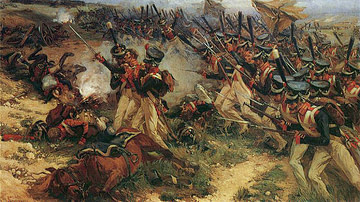
Image
Attack of the Russian Imperial Guard at Borodino
Attack of the Russian Imperial Guard during the Battle of Borodino (7 September 1812). The regiment would lose 973 out of its original 1740 men during the battle. By N. S. Samokish, 1912.
Image
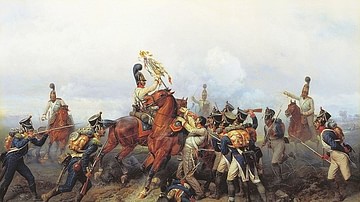
Russian Imperial Guard Captures a French Eagle
During the latter stages of the Battle of Austerlitz (2 December 1805), the cavalry of the Russian Imperial Guard launch a desperate charge on the Pratzen Heights, seizing an Eagle standard from the French 4th Line Regiment. Shortly after...

Image
Russian Hamlet by Kryjitski
An 1884 oil-on-canvas painting by Constantin Kryjitski (1858-1911) showing a Russian hamlet or khutir.
Image
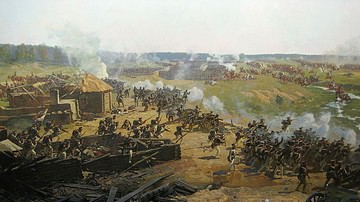
Russian Troops at Borodino
Line of Russian soldiers at the Battle of Borodino, part of the Panorama of Borodino by Franz Roubaud.
Battle of Borodino Museum-panorama.
Definition
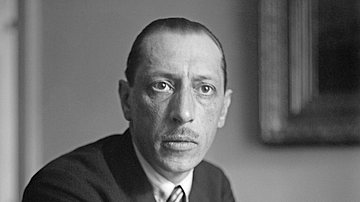
Igor Stravinsky
Igor Stravinsky (1882-1971) was a Russian composer best known for his works for the stage, such as the ballets The Firebird, Petrushka, and the groundbreaking The Rite of Spring. The modernist composer lived in Switzerland, France, and then...

Image
Government of the Roman Republic
This infographic illustrates the government of the Roman Republic (c. 509–27 BCE), a political system that combined elements of monarchy, aristocracy, and democracy. Over nearly five centuries, the Republic developed institutions designed...

Quiz
Government & Society in Ancient Rome
Roman Government society Consul Praetor Aedile Quaestor Censor Plebeians Patricians Equites Freedmen SPQR Tribal Assembly Centuriate Assembly The Senate The Tribune

Image
Carthaginian Government
An artist's impression of what a scene from Carthaginian or Near Eastern government may have looked like.

Definition
Ancient China
Ancient China produced what has become the oldest extant culture in the world. The name 'China' comes from the Sanskrit Cina (derived from the name of the Chinese Qin Dynasty, pronounced 'Chin') which was translated as 'Cin' by the Persians...
