
Search
Remove Ads
Advertisement
Search Results

Article
The Stolypin Reforms - Tsar Nicholas II's Attempt to Stave off Revolution
Pyotr Stolypin (1862-1911) was a Russian politician who served as prime minister to Tsar Nicholas II (reign 1894-1917). Stolypin ruthlessly quashed anti-Tsarist rebellions after the Russian Revolution of 1905 but was also responsible for...

Lesson Pack
Mesopotamia: Government & Religion
This lesson pack on government and religion in ancient Mesopotamia includes the following content: Three Lesson Plans - Rise of City States - Temples & Divine Kingship - Code of Hammurabi Additional Materials - Open Questions /...

Definition
Peter the Great
Peter I of Russia (Peter the Great) was the Tsar of Russia from 1682-1721 and Emperor of Russia from 1721-1725. During his long reign, Peter had absolute power and brought real change to Russia, including building its first navy, introducing...
Article
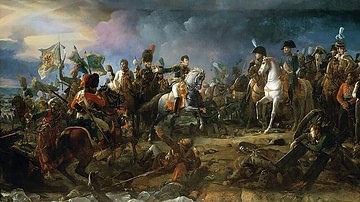
Battle of Austerlitz
The Battle of Austerlitz (2 December 1805), or the Battle of the Three Emperors, was one of the most significant battles of the Napoleonic Wars (1803-1815). It saw French Emperor Napoleon I (r. 1804-1814; 1815) and his Grande Armée decisively...

Definition
Iranian Revolution
The Iranian Revolution (1978-1979) was the social movement that arose from widespread and diverse discontent with the monarchic government of Iran. The revolution was fought against the regime of Mohammad Reza Shah (r. 1941-1979), and it...

Image
Map of the Russian Revolution of 1905
This map illustrates the Russian Revolution of 1905, a wave of political and social unrest across the Russian Empire following defeat in the Russo-Japanese War (1904-5). The revolution was sparked by Bloody Sunday on 22 January 1905, when...

Article
The Murder of the Romanov Family
The brutal murder of the entire Romanov family was the culmination of deep discontent across the Russian Empire with the persistently autocratic rule of Tsar Nicholas II (reign 1894-1917). Following the disaster of the First World War (1914-18...

Collection
Government in Ancient Rome
Roman government revolved around the Roman Senate with its body of aristocratic citizens who distinguished themselves from everyone else with their titles, purple-striped togas, senatorial rings and even special shoes. Senators held the key...

Collection
Ancient Egypt: Government & Religion
Government and religion in ancient Egypt were fully integrated beginning with the First Dynasty of Egypt (c. 3150 to c. 2890 BCE). The king was understood as a representative of a god, the specific deity sometimes changing with different...

Collection
Mesopotamia: Government & Religion
The polytheistic religion of ancient Mesopotamia was instrumental in shaping its government and held great significance in the lives of its people. Mesopotamian religion revolved around the belief that humans were created to work alongside...
