
Search
Remove Ads
Advertisement
Search Results

Definition
George II of Great Britain
George II of Great Britain (r. 1727-1760) was the second of the Hanoverian monarchs, and like his father George I of Great Britain (r. 1714-1727), he faced a Jacobite rebellion to restore the Stuart line. Wars in Europe...

Definition
Vespasian - The Commoner Who Became Roman Emperor
Vespasian (9-79 CE) was Roman emperor from 69 to 79 CE. Despite his low birth, he worked hard to rise through the ranks of Roman politics and eventually achieved prominence as a military commander. He...

Definition
Coup of 18 Brumaire
The Coup of 18 Brumaire (9-10 November 1799) was a bloodless coup d'état in France that overthrew the government of the French Directory and replaced it with the French Consulate. The coup brought Napoleon Bonaparte to power...

Definition
Belisarius
Flavius Belisarius (l. 505-565 CE) was born in Illyria (the western part of the Balkan Peninsula) to poor parents and rose to become one of the greatest generals, if not the greatest, of the Byzantine Empire. Belisarius is listed...
Definition
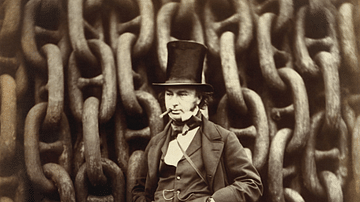
Isambard Kingdom Brunel
Isambard Kingdom Brunel (1806-1859) was a British engineer and a key figure of the British Industrial Revolution (1760-1840). Brunel masterminded the Great Western Railway from London to Bristol, designed and built innovative...

Definition
Karnak
Karnak is the modern-day name for the ancient site of the Temple of Amun at Thebes, Egypt. The Egyptians called the site Nesut-Towi, "Throne of the Two Lands", Ipet-Iset, "The Finest of Seats" as well as Ipt-Swt, "Selected Spot" also...

Definition
Suleiman the Magnificent
Suleiman the Magnificent (aka Süleyman I or Suleiman I, r. 1520-1566) was the tenth and longest-reigning sultan of the Ottoman Empire. Hailed as a skilled military commander, a just ruler, and a divinely anointed monarch...

Definition
Chariot
The chariot was a light vehicle, usually on two wheels, drawn by one or more horses, often carrying two standing persons, a driver and a fighter using bow-and-arrow or javelins. The chariot was the supreme military weapon in Eurasia...

Definition
Western Astrology
Western astrology refers to a form of divination based on the motion of astronomical objects such as stars or planets. The belief that astronomical objects are divine or influence events on Earth is found in many cultures, but...

Definition
Battle of Pydna
The Battle of Pydna in June 168 BCE was a decisive Roman victory that ended the Third Macedonian War and established Rome as the dominant power in the Mediterranean. The Roman Republic was expanding, enlarging its sphere of influence...
