
Search
Search Results

Definition
Mars
Mars was the Roman god of war and second only to Jupiter in the Roman pantheon. Although most of the myths involving Mars were borrowed from the Greek god of war Ares, Mars did have some uniquely Roman features. Mars is considered more level-headed...

Video
Rome: An Empire's Story with Greg Woolf
In our interview with Greg Woolf, we chat all about the second edition of his book Rome: An Empire's Story. What's the book about? Well, It's a total history of Rome. It starts with the 8th century BCE, when it's just a scatter of villages...

Definition
Justinian I
Justinian I reigned as emperor of the Byzantine Empire from 527 to 565 CE. Born around 482 CE in Tauresium, a village in Illyria, his uncle Emperor Justin I was an imperial bodyguard who reached the throne on the death of Anastasius in 518...

Definition
Clovis I
Clovis I (or Chlodovech, 466-511/513 CE), king of the Franks, is considered the founding father of the Merovingian Dynasty, which would continue for over 200 years. Clovis became king at the age of 15, and by the time of his death 30 years...
Definition
Battle of Adrianople
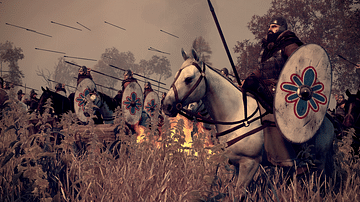
The Battle of Adrianople on August 9, 378 CE ranks among the worst military defeats in all of Roman history. Its estimated losses of over 10,000 are comparable to Roman defeats at Cannae (216 BCE) and Carrhae (53 BCE). The battle pitted the...
Definition
Edward Gibbon
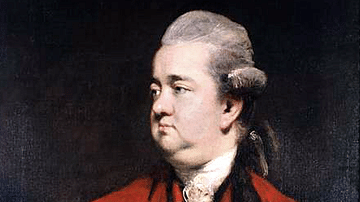
Edward Gibbon (1737-1794) was an English historian most famous for his influential work The History of the Decline and Fall of the Roman Empire, volume one of which was published in 1776, with the final sixth volume coming in 1788. Gibbon's...

Definition
Childeric I
Childeric I (r. c. 458-481) was a late antiquity king of the Salian Franks during the period of the fall of the Western Roman Empire. Childeric's reign solidified the Salians as a dominant Frankish tribe and helped pave the way for the unification...

Image
She-wolf mosaic
Mosaic depicting the She-wolf with Romulus and Remus, inspired by the legend of the founding of Rome. From Aldborough (UK), about 300-400 CE (Leeds City Museum).
Image
Cherub Detail from Paleochristian Sarcophagus
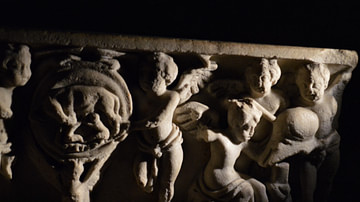
Detail of cherubs from a paleochristian sarcophagus (c. 4th to 6th century CE), showing a crest with the wolf that suckled Romulus and Remus (left) and cherubs forging Mars' helmet (right). In the crypt of the Abbey of St. Victor, Marseille...

Article
Ancient Roman Society
Rome began as a small city on the banks of the Tiber River in Italy. The Latin tribes (also known as the Latini or Latians) inhabited the region c. 1000 BCE but the founding of the city is dated to 753 BCE. The family was the center and foundation...
