
Search
Remove Ads
Advertisement
Search Results
Definition
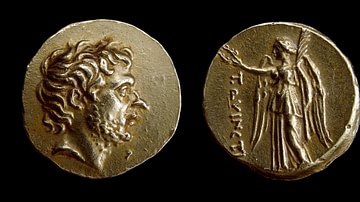
Titus Quinctius Flamininus
Titus Quinctius Flamininus (229-174 BCE) was a consul and military commander of the Roman Republic during the Second Macedonian War, who decisively defeated Philip V of Macedon (r. 221-179 BCE) at the Battle of Cynoscephalae...

Definition
Amphitheatre - The Roman Contribution to Public Architecture
An amphitheatre was a structure built throughout the Roman empire where ordinary people could watch such spectacles as gladiator games, mock naval battles, wild animal hunts, and public executions...

Definition
Berbers
The Berbers have occupied North Africa, specifically the Maghreb, since the beginning of recorded history and until the Islamic conquests of the 8th century CE constituted the dominant ethnic group in the Saharan region. Modern Berber...

Definition
Ptolemaic Egypt
Ptolemaic Egypt existed between 323 and 30 BCE when Egypt was ruled by the Macedonian Ptolemaic dynasty. During the Ptolemaic period, Egyptian society changed as Greek immigrants introduced a new language, religious pantheon...
Definition
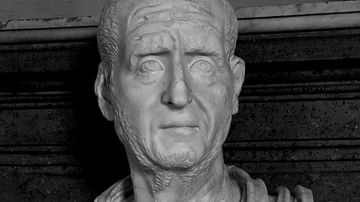
Decius
Decius was Roman emperor from 249 to 251 CE. In 249 CE Roman emperor Philip the Arab sent senator Decius to be the governor of the troubled provinces of Moesia and Pannonia. Roman legions under the ineffective command of the governor...

Definition
Mosaic
Mosaics are designs and images created using small pieces (tesserae) of stone or other materials which have been used to decorate floors, walls, ceilings, and precious objects since before written records began. Like pottery, mosaics...
Definition
De Officiis
De Officiis is a treatise written by Marcus Tullius Cicero (106 – 43 BCE), Roman statesman and orator, in the form of a letter to his son just after the death of Julius Caesar in 44 BCE. Strongly influenced by stoicism, De Officiis...

Definition
Chandragupta Maurya
Chandragupta Maurya (c. 321 - c. 297 BCE), known as Sandrakottos (or Sandrokottos) to the Greeks, was the founder of the Maurya Dynasty (4th-2nd century BCE) and is credited with the setting up of the first (nearly) pan-Indian...

Image
Roman Soldier Guards a Captured Gaul
This is a terracotta relief. Captured weapons and a cloak hang on a tree as a trophy (symbol of victory). The stamped inscription M(arcus) Anton(ius) Epaphra(s) refers to the workshop producing the plaque. Made...
Image
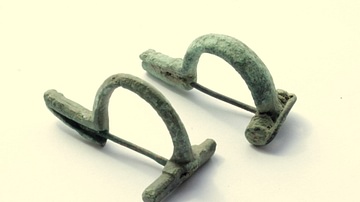
Roman Fibulae
Two P-shape bronze fibulae. 2nd-3rd century CE. Provenance unknown. (private collection)
