
Search
Did you mean: Roman Fort?
Remove Ads
Advertisement
Search Results

Definition
Western Roman Empire
The Western Roman Empire is the modern-day term for the western half of the Roman Empire after it was divided in two by the emperor Diocletian (r. 284-305 CE) in c. 285/286 CE. The Romans themselves did not use this term. At its height (c...

Definition
Roman Empire
The Roman Empire, at its height (c. 117), was the most extensive political and social structure in western civilization. Building upon the foundation laid by the Roman Republic, the empire became the largest and most powerful political and...

Article
Mehrauli Archaeological Park
Mehrauli Archaeological Park is situated in Delhi, just beside the Qutb Complex (historically, Mehrauli was the first of the seven cities of Delhi). Spanning an area of more than 200 acres (80 ha), the site displays the rich heritage of India...

Definition
Roman Religion
In many societies, ancient and modern, religion has performed a major role in their development, and the Roman Empire was no different. From the beginning Roman religion was polytheistic. From an initial array of gods and spirits, Rome added...
Definition
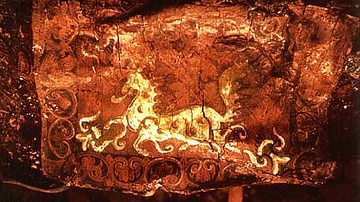
Cheonmachong
Cheonmachong is a 5-6th-century CE royal tomb of the ancient Silla kingdom of Korea located at the Daereungwon Tomb Complex in Gyeongju. It is popularly known as the 'Heavenly Horse Tomb' because of a painting of that animal on a birch-bark...
Article
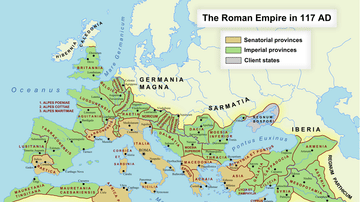
The Extent of the Roman Empire
Time has seen the rise and fall of a number of great empires - the Babylonian, the Assyrian, the Egyptian, and lastly, the Persian. Regardless of the size or skill of their army or the capabilities of their leaders, all of these empires fell...
Article
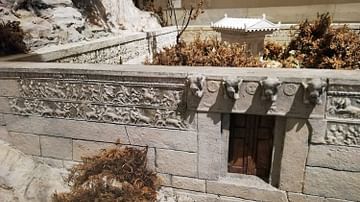
The Heroon of Trysa: A Lycian Tomb Reappears
The Heroon of Trysa was the tomb of a powerful Lycian dynast surrounded by a precinct wall covered with remarkable mythological friezes. It was discovered in 1841 CE when a Polish-Prussian school teacher and classical philologist, Julius...

Article
Treasures of Roman Tunisia - 10 Key Sites Explored
Set on the North African coast, Tunisia is home to some of the finest Roman ruins in the Mediterranean. After the fall of Carthage, Rome transformed the region into the prosperous province of Africa, enriched by its fertile plains and bustling...

Definition
Tutankhamun
Tutankhamun (also known as Tutankhamen and `King Tut', r. c.1336-c.1327 BCE) is the most famous and instantly recognizable Pharaoh in the modern world. His golden sarcophagus is now a symbol almost synonymous with Egypt. His name means `living...

Definition
Roman Mythology
The ancient Romans had a rich mythology and, while much of it was derived from their neighbors and predecessors, the Greeks, it still defined the rich history of the Roman people as they eventually grew into an empire. Roman writers such...
