
Search
Did you mean: Roman Fort?
Remove Ads
Advertisement
Search Results

Definition
Tutankhamun
Tutankhamun (also known as Tutankhamen and `King Tut', r. c.1336-c.1327 BCE) is the most famous and instantly recognizable Pharaoh in the modern world. His golden sarcophagus is now a symbol almost synonymous with Egypt. His name means `living...

Article
Top 5 Roman Sites in Southern Spain
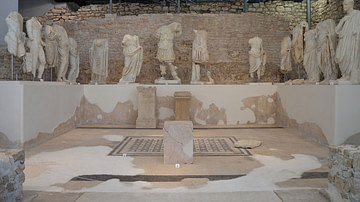
Almost 700 years of continuous Roman occupation have left impressive traces in the Spanish landscape. Spain was then known as 'Hispania' and is now a fascinating location for the archaeological traveller. The Spanish provinces were amongst...
Definition
Roman Imperial Cult
The Roman imperial cult was the practice of venerating Roman emperors and their families as having divine attributes, honoring their contributions to the spread of Roman religion and culture. It was instituted by the first Roman emperor Augustus...

Definition
Holy Roman Empire
The Holy Roman Empire officially lasted from 962 to 1806. It was one of Europe’s largest medieval and early modern states, but its power base was unstable and continually shifting. The Holy Roman Empire was not a unitary state, but a confederation...

Article
Mandu - City of Joy
The city of Mandu is situated about 35 km from Dhar in the Madhya Pradesh region of northern-central India. Most of the city's monuments date to the 15th and 16th century CE. The city is located on a hill which rises 633 m above the sea level...

Article
Roman Warfare in the Age of Pyrrhus
The Roman army fought many conflicts throughout its long history, though perhaps none so indelible as the Pyrrhic War from 280 to 275 BCE. This war between Rome and a league of Greek colonies in southern Italy led by the city of Tarentum...

Definition
Roman Cavalry
Cavalry, although never replacing infantry as the mainstay of the Roman army, could provide useful cover on the flanks of armies, could be used as a shock tactic to cause disruption to enemy infantry formations, and could pursue an enemy...

Definition
Attila the Hun
Attila the Hun (r. 434-453 CE) was the leader of the ancient nomadic people known as the Huns and ruler of the Hunnic Empire, which he established. His name means "Little Father" and, according to some historians, may not have been his birth...

Definition
Harper's Songs of Ancient Egypt
Harper's songs were lyrics composed in ancient Egypt to be sung at funeral feasts and inscribed on monuments. They derive their name from the image which accompanies the text on tomb or chapel walls, stelae, and papyri in which a blind harper...

Article
The Splendours of Roman Algeria
Algeria, Africa's largest country, stretches from the Mediterranean coastline to the Saharan desert interior. The country has some of the finest and most diverse Roman sites, including Timgad and Djémila, both well-preserved and UNESCO-listed...
