
Search
Did you mean: Jomon Pottery?
Remove Ads
Advertisement
Search Results
Image
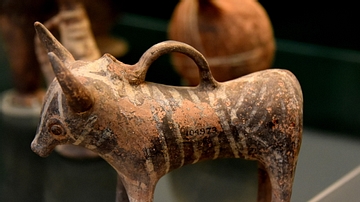
Imported Cypriot Pottery Bull to the Levant
During the Late Bronze Age, the trade contacts established with Cyprus in the preceding period were intensified. This type of bull was very popular in the Levant, either as ornaments or perhaps as feeding...

Image
Stamped Pottery Jar from Tell al-Khulayfi
An oval seal impression repeated on the rim and handles of a large jar. Seal impressions are official guarantees of the jars and their contents; therefore, stamped jars indicated the presence of a local administrative...

Image
Ammonite Pottery Bottle
Carrot-shaped bottle, burnished and decorated with horizontal bands. This characteristic type was probably made for special liquids, such as cosmetics or medicinal oils. Locally made in an Assyrian form, such bottles link...
Image
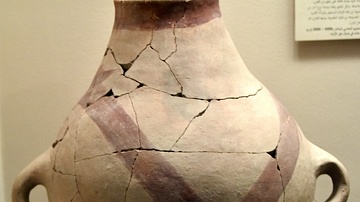
Decorated Pottery Jar from Abu Hamid
This type is similar to the ones used for infant burials, but this one is painted with red strips using iron oxide (hematite), material already known during the Neolithic period for coloring plaster. The Jar was...

Image
Pottery Figurine from Tell al-Sa'idiyya
This is the upper half of a female figurine. Her facial features, hair, and necklace were carefully made in spite of being small in size. The breasts are prominent. Late Bronze Age, 1550-1200 BCE. From Tell...

Image
Meroitic Pottery Flask
This is a red burnished globular flask with a wide mouth. The flask has been incised with decoration of horizontal bands at the neck and shoulder above an impressed design of triangles. From cemetery 300 at Meroe, Sudan...
Image
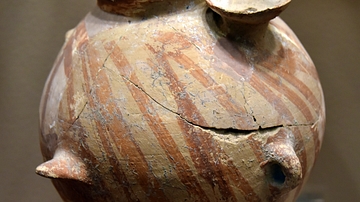
Painted Pottery Jar from Arqub az-Zahr
Jar decorated in red, like a burnished slip or groups of lines The spouts applied to some jars may have served as stands for dipper juglets. Early Bronze Age, 3600-3100 BCE. From Arqub az-Zahr, Jordan. (The Jordan...
Image
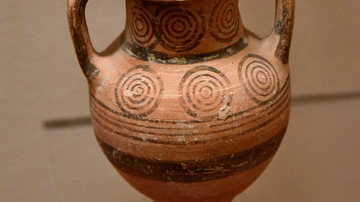
Cypro-Phoenician Pottery Vessel
This vessel belongs to a ceramic tradition known as "black-on-red" ware, the most ubiquitous of the Iron Age's Cypro-Phoenician exports. Iron Age II, 1000-539 BCE. From Amman, Jordan. (The Jordan Museum, Amman, Jordan...

Image
Pottery Ossuary from Azor
Chests of this sort were used to contain the bones of individuals in secondary burials. These were burials in which the body had been exposed and allowed to decay before the bones were gathered. At Azor, on the coast of...

Definition
The Goths
The Goths were a Germanic tribe who are frequently referenced for their part in the fall of the Roman Empire and their subsequent rise to power in the region of northern Europe, initially in Italy. Prior to their contact with Rome...
