
Search
Did you mean: Roman Mosaics?
Remove Ads
Advertisement
Search Results
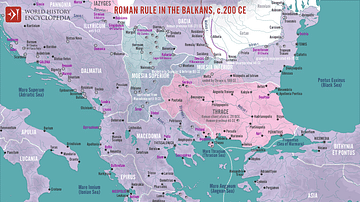
Image
Roman Rule in the Balkans, c. 200 CE
A map illustrating Roman rule in the Balkans around 200 CE, characterized by significant administrative, military, and cultural integration into the Empire. The region was divided into several provinces (Moesia...

Definition
Amphitheatre - The Roman Contribution to Public Architecture
An amphitheatre was a structure built throughout the Roman empire where ordinary people could watch such spectacles as gladiator games, mock naval battles, wild animal hunts, and public executions...
Definition
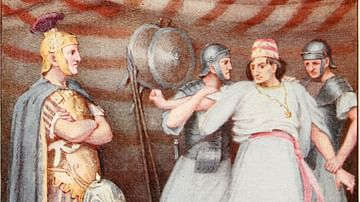
Jugurtha
Jugurtha (r. 118-105 BCE) was King of Numidia in North Africa and grandson of the first Numidian king Masinissa (r. c. 202-148 BCE). He was the illegitimate son of Mastanabal, Masinissa's youngest son, and was the least likely of Masinissa's...
Definition
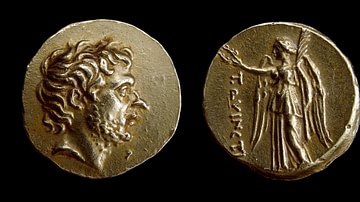
Titus Quinctius Flamininus
Titus Quinctius Flamininus (229-174 BCE) was a consul and military commander of the Roman Republic during the Second Macedonian War, who decisively defeated Philip V of Macedon (r. 221-179 BCE) at the Battle of Cynoscephalae...

Definition
Hilda of Whitby
Hilda of Whitby (also known as Saint Hilda of Whitby, l. 614-680 CE) was the founder and abbess of the monastery at Whitby, Kingdom of Northumbria, Britain. She was a Northumbrian princess who converted to Christianity with the...
Definition
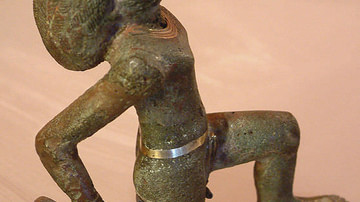
Berbers
The Berbers have occupied North Africa, specifically the Maghreb, since the beginning of recorded history and until the Islamic conquests of the 8th century CE constituted the dominant ethnic group in the Saharan region. Modern Berber...
Definition
De Officiis
De Officiis is a treatise written by Marcus Tullius Cicero (106 – 43 BCE), Roman statesman and orator, in the form of a letter to his son just after the death of Julius Caesar in 44 BCE. Strongly influenced by stoicism, De Officiis...

Definition
Seneca
Lucius Annaeus Seneca (Seneca the Younger, l. 4 BCE - 65 CE) was a Roman author, playwright, orator, and most importantly a tutor and advisor to the Roman emperor Nero (r. 54-68 CE). Influenced by Stoic philosophy, he wrote several philosophical...

Image
Roman Soldier Guards a Captured Gaul
This is a terracotta relief. Captured weapons and a cloak hang on a tree as a trophy (symbol of victory). The stamped inscription M(arcus) Anton(ius) Epaphra(s) refers to the workshop producing the plaque. Made...
Image
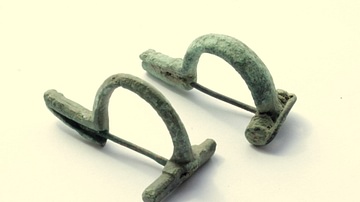
Roman Fibulae
Two P-shape bronze fibulae. 2nd-3rd century CE. Provenance unknown. (private collection)
